A startup founded in 2026 says its AI agents already support operations across more than 1.8 gigawatts of solar capacity [1]. Another company trains AI models to approximate engineering simulations that previously took hours or days [2]. A third searches for flexible connection capacity inside grids that appear constrained [3].
These are commercial products, pilots and early deployments, not simply research concepts. Together, they attack a growing constraint: AI expansion is increasingly limited by timely access to reliable power.
This guide maps 15 companies across the emerging AI-energy stack. Eleven use AI directly to improve planning, coordination, optimization or operations. Four build the generation and storage that software cannot create on its own.
For each company, we examine the bottleneck, how the technology works, what has actually been deployed and what remains a company-reported target. Funding appears in one line because capital is evidence of market belief, not proof of technical impact.
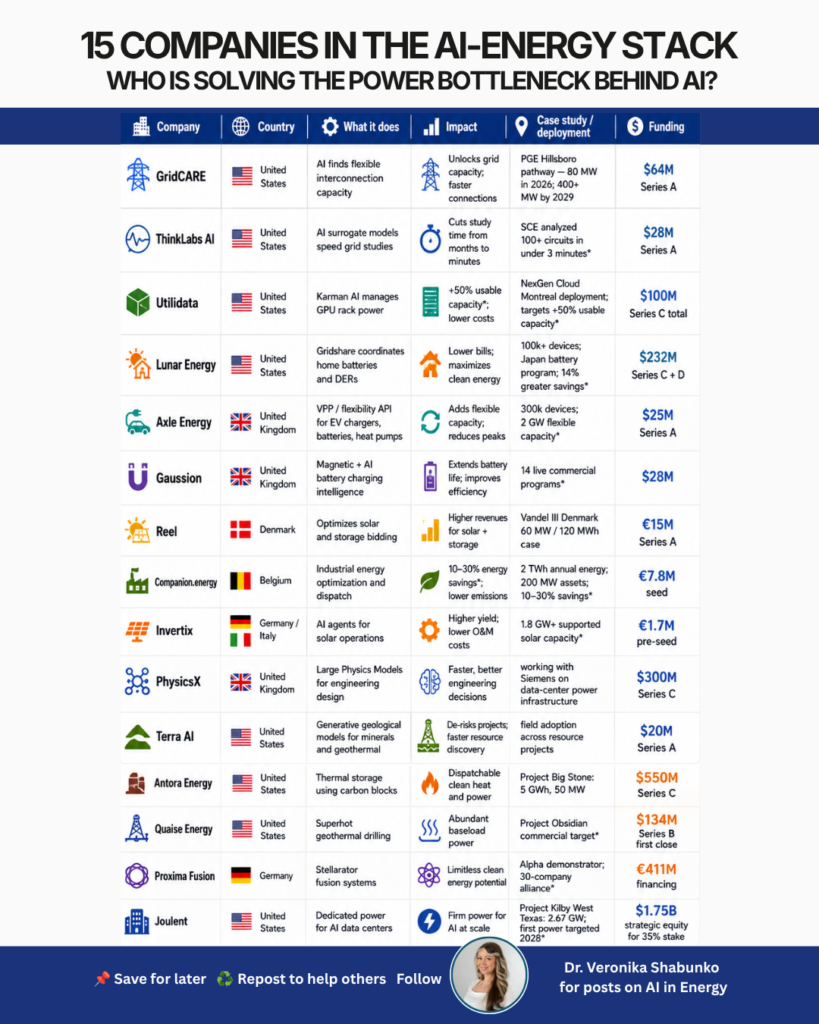
All 15 companies at a glance. Here is the full map before we go layer by layer. Deployment figures marked with an asterisk are company-reported.
First, understand the bottleneck
Three facts explain everything that follows.
-
AI needs enormous power. Gartner projects that data centers will use 565 terawatt hours of electricity in 2026, up 26 percent in a single year. AI servers alone will use about 31 percent of that [4]. That is more electricity than most countries consume.
-
Securing power can take longer than building the data center. Connection timelines vary by market, location and project design. GridCARE says the largest AI infrastructure projects can face six-to-ten-year waits for conventional grid service [3]. Separately, Currence estimates that 30 to 50 percent of the data-centre capacity announced for 2026 may not materialize on schedule because of power constraints, construction bottlenecks and uncertain project timelines [5].
-
Parts of the grid are underused for many hours, but that capacity is not automatically available. Stanford researchers note that California’s transmission system uses less than 40 percent of its capacity on average. Yet local congestion, voltage limits, reliability margins and peak conditions can still prevent new connections [6].
The opportunity is therefore not simply to fill “empty wires.” It is to identify where, when and under what operating conditions flexible capacity can be used safely.
The power bottleneck is both physical and informational.
New generation, storage and grid infrastructure are still needed. But the system also lacks sufficiently precise information about where capacity exists, when loads can flex and how new demand will affect the network.
AI is particularly valuable in that information-and-decision layer: it can evaluate more operating conditions, coordinate more devices and respond faster than conventional manual processes.
Now let us see how, layer by layer.
Layer 1: AI that finds hidden capacity in the grid

The technology: grid simulation at machine speed
To connect a big new customer, a utility must answer a physics question. Will the extra load overheat a transformer, sag a voltage, or trip a protection relay anywhere in the network, under any plausible condition? Engineers answer it with power flow studies.
Each study takes weeks, and they test only a handful of worst-case scenarios. To stay safe, planners assume the worst everywhere. That caution helps explain why a network that appears underused on average may still reject new connections at specific locations or under critical operating conditions.
AI changes the economics of the question. Instead of a few hand built scenarios, machine learning models can evaluate millions of them: every hour of the year, every weather pattern, every combination of loads. The grid stops being a black box and becomes a searchable map.
1. GridCARE: searching the map for stranded megawatts
GridCARE’s Energize platform uses generative AI to evaluate quadrillions of grid operating scenarios, modeling congestion, outages, weather, and demand at once. This reveals the rare hours when the network is truly constrained, and the many hours when it is not [3], [6].
GridCARE then works with the utility to connect large loads into those open windows, cutting time to power from years to as little as 6 to 12 months [6]. Think of it like an airline seat map. The plane looks full if you only check one flight. Check every flight, every day, and seats appear.
The result is measurable. A joint project with Portland General Electric identified a pathway to more than 400 megawatts of additional capacity in Hillsboro, Oregon, with the first 80 megawatts expected in 2026 [7]. The full 400 megawatts is not operating yet. But the analysis revealed capacity that conventional planning had not made available.
Backed by a $64M Series A led by Sutter Hill Ventures, with John Doerr and National Grid Partners, May 2026 [3].
2. ThinkLabs AI: compressing a month of engineering into minutes
ThinkLabs attacks the study bottleneck itself. Its models are trained on the outputs of the physics simulators utilities already trust, and then validated against those same simulators. The AI learns to give the same answers the traditional tools give, only thousands of times faster [8].
The gains are dramatic. Work that took an engineer 30 to 35 days per circuit now takes minutes. In a collaboration with Southern California Edison, the platform processed a full year of hourly power flow data across more than 100 circuits in under three minutes [8]. This approach is called a surrogate model. The AI does not replace physics. It learns physics, then answers faster than the original solver ever could. The company reports working with more than ten utilities [8].
Backed by a $28M Series A with NVIDIA and Edison International, March 2026 [8].
3. Utilidata: AI inside the data center rack
Utilidata moves the intelligence to the other side of the meter. Its Karman platform is a small AI computer, built on a custom NVIDIA Jetson module, that embeds directly into the power distribution equipment inside a data center [9], [10].
Here is why that matters. A data center buys a grid connection sized for its single worst moment of demand. Most of the time it uses far less. GPU workloads also swing violently, and those swings can push instability back onto the grid. Karman watches power at the rack level in real time, smooths the swings, and lets operators safely pack more computing into the same connection.
Utilidata targets up to 50 percent more usable capacity from existing infrastructure, a company figure that its first commercial deployment with NexGen Cloud in Montreal will now test [9].
Backed by a $100M Series C including NVIDIA and Quanta Services, completed May 2026 [9].
What to remember from Layer 1: the grid’s shortage is not always copper. Sometimes it is knowledge. AI can reveal capacity that conventional planning does not make visible, and help some projects move from multi-year waits to much shorter connection timelines.
Layer 2: AI that turns homes into power plants
The technology: the virtual power plant
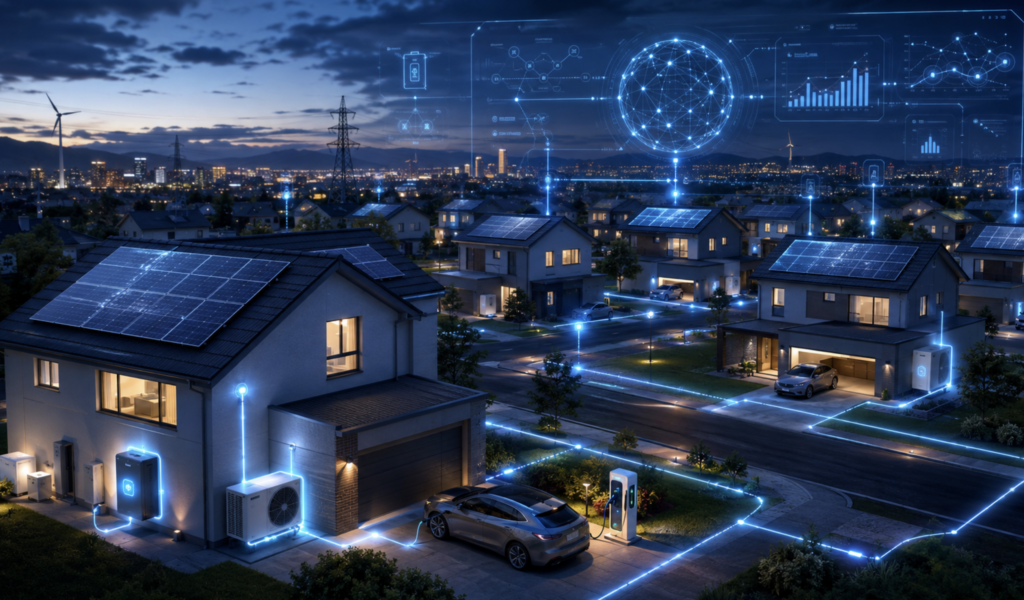
Millions of home batteries, EV chargers and heat pumps already sit connected to the grid. Each one can shift when it uses or stores power without the owner noticing. A warm home stays warm. A car still charges by morning. Only the timing changes.
Individually these devices are tiny. Coordinated, they are enormous. Software that aggregates thousands of them and controls them as one dispatchable resource is called a virtual power plant, or VPP. The AI inside a VPP does three jobs. It forecasts what each device will need, using usage patterns, weather and grid conditions. It decides which devices to call on and when. And it bids the combined flexibility into electricity markets, so everyone gets paid.
4. Lunar Energy: the integrated approach
Lunar builds both the home battery and the brain. Its AI studies each household’s usage patterns alongside grid and weather conditions, then charges and discharges the battery at the most valuable times while always keeping backup power in reserve [11]. Its Gridshare platform supports virtual power plant programs with partners including Sunrun.
Lunar reports that the platform coordinates approximately 130,000 residential energy devices, representing around 650 MW of connected inverter capacity across several markets [11]–[13].
The design principle is interoperability. Lunar’s batteries work with any grid software, and Gridshare works with any battery. That choice is what let a hardware company become the operating system for other people’s hardware.
Backed by $232M across Series C and D, with Sunrun as both customer and investor, February 2026 [13].
5. Axle Energy: the connective tissue approach
Axle owns no hardware at all. It provides one software interface that connects EV chargers, batteries and heat pumps, from any manufacturer, to electricity markets. Its systems handle the whole chain: forecasting each device’s availability, aggregating them into blocks the market can trade, bidding, dispatching in real time, and settling payments afterwards [14].
The scale is the striking part. Axle says it coordinates more than 300,000 devices representing over 2 gigawatts of flexible capacity, roughly the output of a large nuclear plant, aggregated from EV chargers, batteries and heat pumps in customers’ homes [15]. Households in its programs earn around 10 pounds a month for letting the software shift their timing [16]. Both figures come from the company and its lead investor.
Backed by a $25M Series A led by Energize Capital, July 2026 [14].
What to remember from Layer 2: the fastest power plant to build is the one that already exists. The AI contribution is coordination: forecasting, deciding and trading for a million small machines at once.
Layer 3: AI that squeezes more from every asset

6. Gaussion: physics plus AI at the battery cell
Fast charging damages lithium ion batteries. The lithium ions crowd and plate onto the anode, heat builds, and lifespan drops. The usual fix is new chemistry, which takes a decade to commercialize.
Gaussion, a spinout from University College London and the Faraday Institution, takes a shortcut. A small magnetic device retrofits onto the battery pack. The magnetic field changes how ions move during charging, cutting the heat and stress that cause damage. An AI control layer, the company’s Aeon chip and software, learns each battery’s behavior and manages the field in real time.
Gaussion says the result is faster charging and longer life without changing the underlying cell chemistry or battery design. The technology is now being evaluated across automotive, aerospace, data-center and consumer-electronics programs [17], [18].
Backed by $28M co led by BGF and AlbionVC, with early Tesla investor Steve Jurvetson, June 2026 [17].
7. Reel: algorithmic trading for renewables
A solar park’s problem is not making power. It is selling power at the right moment. Prices in European markets now swing minute by minute, and a plant that sells passively earns less every year as more renewables flood the same sunny hours.
Reel’s algorithms trade each asset’s output across several markets at once: day ahead, intraday, and balancing. The software forecasts production and prices, then continuously repositions to capture the best value [19]. On the other side, it converts that optimized revenue into fixed-price contracts for business customers, so companies get stable bills while producers get better returns. Reel already balances and optimizes one of the largest combined sites in the Nordics, Denmark’s Vandel III, which pairs a 60 megawatt battery with a 162 megawatt solar park [20].
Backed by a €15M Series A led by Future Energy Ventures, May 2026 [21].
8. Companion.energy: the autopilot for industrial energy
Most large factories still manage energy with spreadsheets and quarterly reviews, even while they install solar panels, batteries, electric boilers and EV chargers. Every one of those assets creates decisions: charge now or later, run the boiler on cheap power or gas, sell flexibility or keep it.
Companion.energy connects the company’s energy contracts, its operational systems and its physical assets into one platform, then automates those decisions in real time as prices move [22]. It is best understood as an autopilot: the human sets the goals, the software flies the plane continuously.
The platform already manages more than 2 terawatt hours of yearly consumption and production and controls over 200 megawatts of distributed assets for customers including TotalEnergies and the Port of Antwerp Bruges [22], [23].
Backed by a €7.8M seed co led by Realyze Ventures and Pi Labs, June 2026 [22].
9. Invertix: AI agents that operate solar farms
This is the newest idea on the list: agentic AI applied to power plants. A solar farm’s control system, called SCADA, generates a constant stream of alarms, performance data and compliance duties. Traditionally, human operators in a control room read all of it and decide what to do. Europe is building solar far faster than it can hire those operators.
Invertix shifts much of the routine monitoring and analysis from human operators to AI agents, while keeping people in control of higher-consequence decisions. The agents plug into the SCADA, maintenance and business systems a plant already runs. They diagnose faults, analyze performance, write compliance reports and coordinate repairs, under adjustable levels of autonomy so humans stay in charge of the calls that matter [1], [24].
Under the hood the platform combines several AI models, including large language models for reasoning and document processing [25]. Setup takes about 60 days. The company reports its agents already operate more than 1.8 gigawatts of solar, a company figure from a startup founded in February 2026, so weigh it accordingly [24], [25].
Backed by a €1.7M pre seed led by Vireo Ventures, May 2026 [24].
What to remember from Layer 3: the same assets can do much more work when software makes their decisions. This is why tiny teams now touch gigawatts. The AI is not building anything. It is thinking for things that already exist.
Layer 4: AI for the physical world behind energy
10. PhysicsX: learning physics itself
Every machine in the energy system, from gas turbines to cooling systems to chips, is designed with simulation. Engineers model airflow, heat and stress, and each simulation run can take hours or days. That speed limit caps how many designs anyone can try.
PhysicsX trains what it calls Large Physics Models: AI that learns from those simulations and then predicts the physics directly, in seconds instead of days [2]. It is the same surrogate model idea we saw with ThinkLabs, applied to engineering design. Instead of waiting hours or days for each simulation, engineers can evaluate many more turbine, cooling and semiconductor designs in the same amount of time.
The company’s fastest growing market is the hardware AI data centers depend on, and semiconductors are expected to become its largest segment [26]. It touches no megawatts directly. It designs the machines that make the megawatts useful.
Backed by a $300M Series C led by Temasek at a $2.4B valuation, with NVIDIA and Siemens, June 2026 [2].
11. Terra AI: generative AI for what lies underground
The energy transition runs on copper, rare earths and geothermal heat. Finding them means guessing what sits below the surface from scattered drill holes, and a typical mineral discovery takes 17 years to reach production [27].
Terra AI treats the underground as a generation problem. Its models fuse geophysics, geochemistry and drilling data, then generate millions of possible geological models with probabilities attached [27]. Instead of one best guess map, explorers get a full range of scenarios and can drill where uncertainty is highest and value most likely. It is the same idea behind generative AI for images, pointed at rock.
Backed by a $20M Series A led by Khosla Ventures, with miners BHP and Rio Tinto as investors, June 2026 [27], [28].
What AI Cannot Solve Alone: Building New Power
Everything above helps the energy system use existing infrastructure more intelligently. But software cannot replace generation, storage, transformers or transmission. A second group of companies is therefore building the physical power infrastructure the AI economy still needs.
12. Antora Energy: heat batteries for industry
Antora Energy stores cheap renewable electricity as heat in blocks of solid carbon, then releases it as steady power and industrial heat. Its 5 gigawatt-hour system in South Dakota has been commissioned and is delivering energy, with full operation expected later in 2026 [29]. Antora raised $550M in Series C funding in July 2026 [30].
13. Quaise Energy: superhot geothermal anywhere
Quaise Energy adapts millimeter-wave drilling to reach superhot rock far deeper than conventional geothermal wells, aiming to produce clean baseload power in more locations. Quaise raised $134M in the first close of its Series B in July 2026 [31].
14. Proxima Fusion: the stellarator bet
Proxima Fusion is commercializing a stellarator fusion reactor, a magnetic-confinement design intended to sustain plasma in steady-state operation. Proxima raised €411M in financing in July 2026 [32].
15. Joulent: contracted power for data centers
Joulent develops contracted power and electrical-infrastructure solutions for large data-center loads. In July 2026, National Grid Ventures agreed to invest $1.75 billion for a 35% stake in the company, forming a strategic partnership focused on U.S. data-center and AI demand [33].
The pattern matters more than the numbers. The software layer sells time. The hardware layer sells electrons. Both are needed, but the largest cheques are now moving toward the physical infrastructure AI cannot operate without.
Key takeaways
-
The energy bottleneck is partly an information problem. Better forecasting, faster studies and more granular data can reveal capacity that conventional planning may overlook. But the opportunity varies by location and does not remove the need for physical grid expansion.
-
One AI pattern appears everywhere: the surrogate model. ThinkLabs and PhysicsX both train AI on trusted physics simulators, then answer the same questions thousands of times faster. Expect this pattern across every engineering field.
-
Coordination is a superpower. Lunar and Axle show how hundreds of thousands of distributed devices can collectively provide gigawatt-scale flexibility. The devices already existed; aggregation, dispatch rights and market access made them useful to the grid.
-
AI agents are entering physical operations. Invertix illustrates how language-model-based agents may automate alarm review, diagnostics, reporting and workflow coordination in renewable-energy operations. Human supervision remains essential, particularly for safety-critical decisions.
-
Judge technology by deployment, not by funding. The smallest round in this article touches the most megawatts. Always ask what is actually running in the field.
-
Software alone will not close the gap. July’s hardware wave, from thermal storage to deep geothermal, shows the market concluding that smarter grids and new generation are both required.
Want to go deeper?
This guide is the map. The territory changes every quarter.
If you want to keep up with how AI is reshaping energy, join the AI in Energy X newsletter. Every edition breaks down one technology in plain language, tracks which of these 15 companies actually deliver on their claims, and flags the new players before they make headlines.
Subscribe free here → https://ainenergyx.kit.com/join
📥 Free download: The July 2026 AI in Energy Report. Every funding round, deployment milestone, and policy move from July in one PDF.
Get the free report → https://ainenergyx.kit.com/julyreport
Frequently Asked Questions
What is AI in energy?
AI in energy refers to the use of artificial intelligence to improve how electricity is generated, transmitted, stored, and consumed. AI helps utilities forecast demand, optimize grid operations, manage renewable energy, support energy-asset operations, and identify available grid capacity faster than traditional methods.
Why is energy becoming a bottleneck for AI?
Modern AI data centers require enormous amounts of electricity. In many regions, obtaining sufficient grid capacity takes years because utilities must complete complex engineering studies and build new infrastructure. This has made reliable power one of the biggest constraints on AI expansion.
How does AI improve electricity grids?
AI analyzes large volumes of grid data to model power flows, predict congestion, optimize equipment usage, and identify underutilized capacity. These insights help utilities make faster planning decisions and can reduce connection delays for new electricity users.
What is a virtual power plant (VPP)?
A virtual power plant is software that coordinates thousands of distributed energy resources, such as home batteries, electric vehicles, and heat pumps, so they operate like a single power plant. AI helps forecast energy demand, schedule devices, and respond to changing grid conditions.
Can AI replace new power plants?
No. AI can improve the efficiency and utilization of existing infrastructure, but it cannot generate electricity on its own. Expanding electricity supply still requires investments in generation, storage, transmission lines, substations, and other physical infrastructure.
How is AI used in renewable energy?
AI helps renewable energy operators forecast weather, optimize battery charging and discharging, monitor equipment performance, automate maintenance, detect faults, and maximize revenue by responding to electricity market prices.
What are AI agents in energy operations?
AI agents are software systems that can monitor equipment, analyze operational data, generate reports, recommend actions, and complete defined workflows with varying levels of autonomy. In energy operations, they can assist with solar farms, batteries and industrial energy assets, while human operators retain responsibility for safety-critical and higher-consequence decisions.
References
[1] Startupbusiness, “Invertix secures €1.7 million in pre-seed funding,” startupbusiness.it, May 19, 2026. [Online]. Available: https://www.startupbusiness.it/en/invertix-secures-e1-7-million-in-pre-seed-funding/169704/
[2] PhysicsX, “PhysicsX announces $300M Series C to accelerate physics AI for industrial engineering,” PhysicsX Newsroom, Jun. 8, 2026. [Online]. Available: https://www.physicsx.ai/newsroom/physicsx-announces-300m-series-c-to-accelerate-physics-ai-for-industrial-engineering
[3] GridCARE, “GridCARE raises $64 million Series A from leading AI and energy investors to create a new category: Power Acceleration for AI,” Business Wire, May 14, 2026. [Online]. Available: https://www.businesswire.com/news/home/20260514546216/en/GridCARE-Raises-%2464-Million-Series-A-from-Leading-AI-and-Energy-Investors-to-Create-a-New-Category-Power-Acceleration-for-AI
[4] Gartner, “Gartner Says Data Center Electricity Consumption to Grow 26% in 2026,” Jun. 10, 2026. [Online]. Available: https://www.gartner.com/en/newsroom/press-releases/2026-06-10-gartner-says-data-center-electricity-demand-to-grow-26-percent-in-2026
[5] O. Wang, “Data Center Outlook: Half of 2026 Pipeline May Not Materialize,” Currence, Feb. 24, 2026. [Online]. Available: https://www.currence.ai/blog/data-center-outlook
[6] M. Golden, “5 Ways California Can Meet Rising AI Power Demand,” Stanford Report, Sep. 18, 2025. [Online]. Available: https://news.stanford.edu/stories/2025/09/california-ai-power-demand
[7] Data Center Dynamics, “GridCARE raises $64m in Series A funding round,” datacenterdynamics.com, May 15, 2026. [Online]. Available: https://www.datacenterdynamics.com/en/news/gridcare-raises-64m-in-series-a-funding-round/
[8] VentureBeat, “Nvidia-backed ThinkLabs AI raises $28 million to tackle a growing power grid crunch,” venturebeat.com, Mar. 31, 2026. [Online]. Available: https://venturebeat.com/infrastructure/nvidia-backed-thinklabs-ai-raises-usd28-million-to-tackle-a-growing-power
[9] Utilidata, “Utilidata raises $40 million extension, completing $100M Series C to maximize AI compute capacity,” GlobeNewswire, May 28, 2026. [Online]. Available: https://www.globenewswire.com/news-release/2026/05/28/3302882/0/en/Utilidata-Raises-40-Million-Extension-Completing-100M-Series-C-to-Maximize-AI-Compute-Capacity.html
[10] Data Center Dynamics, “Utilidata raises an additional $40m in Series C funding,” datacenterdynamics.com, May 28, 2026. [Online]. Available: https://www.datacenterdynamics.com/en/news/utilidata-raises-an-additional-40m-in-series-c-funding/
[11] Heatmap News, “Lunar Energy raises $232 million to scale virtual power plants,” heatmap.news, Feb. 4, 2026. [Online]. Available: https://heatmap.news/climate-tech/lunar-energy-vpp
[12] Lunar Energy, “Lunar Energy raises $232 million to scale home battery deployments and AI-powered VPP software,” GlobeNewswire, Feb. 4, 2026. [Online]. Available: https://www.globenewswire.com/news-release/2026/02/04/3232099/0/en/Lunar-Energy-raises-232-million-to-scale-home-battery-deployments-and-AI-powered-VPP-software-to-meet-surging-demand-for-affordable-electricity.html
[13] pv magazine USA, “Lunar Energy raises $232 million to accelerate development of residential storage, VPP software,” pv-magazine-usa.com, Feb. 4, 2026. [Online]. Available: https://pv-magazine-usa.com/2026/02/04/lunar-energy-raises-232-million-to-accelerate-development-of-residential-storage-vpp-software/
[14] Accel, “Our investment in Axle Energy: turning everyday energy devices into grid-scale flexibility,” accel.com, Jul. 2026. [Online]. Available: https://www.accel.com/news/our-investment-in-axle-energy-turning-everyday-energy-devices-into-grid-scale-flexibility
[15] EU-Startups, “As power demand rises from electrification and data centres, London’s Axle Energy raises €21 million for energy flexibility,” eu-startups.com, Jul. 2026. [Online]. Available: https://www.eu-startups.com/2026/07/as-power-demand-rises-from-electrification-and-data-centres-londons-axle-energy-raises-e21-million-for-energy-flexibility/
[16] Energize Capital, “Why we invested in Axle Energy,” energizecap.com, Jul. 2026. [Online]. Available: https://energizecap.com/insights/why-we-invested-in-axle-energy
[17] EU-Startups, “From charging EVs and drones to powering data centres: London-based Gaussion raises €24.5 million,” eu-startups.com, Jun. 29, 2026. [Online]. Available: https://www.eu-startups.com/2026/06/from-charging-evs-and-drones-to-powering-data-centres-london-based-gaussion-raises-e24-5-million/
[18] Osborne Clarke, “Osborne Clarke advises AlbionVC and UCL Technology Fund on $28m funding round in energy intelligence company Gaussion,” osborneclarke.com, Jul. 2026. [Online]. Available: https://www.osborneclarke.com/news/osborne-clarke-advises-albionvc-and-ucl-technology-fund-28m-funding-round-energy-intelligence
[19] OneStopESG, “Reel raises €15M Series A to scale renewable energy trading platform across Germany,” onestopesg.com, May 8, 2026. [Online]. Available: https://onestopesg.com/esg-news/reel-series-a-energy-trading-germany
[20] Energy Storage News, “Startup roundup: $60 million for UK battery maker, €15 million for Danish optimizer,” ess-news.com, May 8, 2026. [Online]. Available: https://www.ess-news.com/2026/05/08/startup-roundup-60-million-for-uk-battery-maker-e15-million-for-danish-optimizer/
[21] EU-Startups, “Copenhagen’s Reel raises €15 million to make renewable energy predictable for businesses and profitable for producers,” eu-startups.com, May 8, 2026. [Online]. Available: https://www.eu-startups.com/2026/05/copenhagens-reel-raises-e15-million-to-make-renewable-energy-predictable-for-businesses-and-profitable-for-producers/
[22] EU-Startups, “Ghent’s Companion.energy raises €7.8 million to help large enterprises manage energy in real time,” eu-startups.com, Jun. 8, 2026. [Online]. Available: https://www.eu-startups.com/2026/06/ghents-companion-energy-raises-e7-8-million-to-help-large-enterprises-manage-energy-in-real-time/
[23] OneStopESG, “Companion.energy raises €7.8 million to scale real-time enterprise energy management across European markets,” onestopesg.com, Jun. 10, 2026. [Online]. Available: https://onestopesg.com/esg-news/companion-energy-seed-round-enterprise-energy
[24] The SaaS News, “Invertix raises €1.7M pre-seed,” thesaasnews.com, May 19, 2026. [Online]. Available: https://www.thesaasnews.com/news/invertix-raises-1-7m-pre-seed
[25] Dealroom, “Invertix raises pre-seed from Vireo Ventures, managing 1.8 GW solar with AI agents,” dealroom.co, May 18, 2026. [Online]. Available: https://app.dealroom.co/news/feed/invertix-raises-pre-seed-from-vireo-ventures-managing-1-8-gw-solar-with-ai-agents
[26] Sifted, “PhysicsX hits $2.4bn valuation after $300m Temasek-led funding round,” sifted.eu, Jun. 8, 2026. [Online]. Available: https://sifted.eu/articles/physicsx-funding-round-temasek-valuation
[27] Terra AI, “Terra AI raises $20M to accelerate mineral and reservoir exploration to meet global critical mineral and energy demands,” PR Newswire, Jun. 3, 2026. [Online]. Available: https://www.prnewswire.com/news-releases/terra-ai-raises-20m-to-accelerate-mineral-and-reservoir-exploration-to-meet-global-critical-mineral-and-energy-demands-302789531.html
[28] Fundraise Insider, “Terra AI raises $20M Series A for mineral exploration,” fundraiseinsider.com, Jun. 7, 2026. [Online]. Available: https://fundraiseinsider.com/blog/terra-ai-raises-20m-series-a-for-mineral-exploration/
[29] Antora Energy and POET, “Antora and POET Commission 5 Gigawatt-Hour Thermal Battery Project to Power South Dakota Industry with Affordable Energy,” May 19, 2026. [Online]. Available: https://www.antora.com/insights/big-stone-release
[30] Antora Energy, “Antora Closes $550 Million in Series C Funding to Meet Surging Energy Demand and Reindustrialize America,” Jul. 30, 2026. [Online]. Available: https://www.antora.com/insights/series-c
[31] Quaise Energy, “Quaise Energy Raises $134 Million in First Close of Series B to Build World’s First Superhot Geothermal Power Plant,” Jul. 7, 2026. [Online]. Available: https://www.quaise.com/news/quaise-energy-raises-134-million-in-first-close-of-series-b-to-build-worlds-first-superhot-geothermal-power-plant
[32] Proxima Fusion, “Proxima Fusion Raises €411 Million to Build Europe’s Commercial Fusion Champion,” Jul. 7, 2026. [Online]. Available: https://www.proximafusion.com/press-news/proxima-fusion-raises-eu411-million-to-build-europes-commercial-fusion-champion
[33] National Grid, “National Grid Ventures to Invest $1.75bn to Accelerate Power Solutions for U.S. Data Centers and AI,” Jul. 1, 2026. [Online]. Available: https://www.nationalgrid.com/national-grid-ventures-invest-175bn-accelerate-power-solutions-us-data-centers-and-ai