Every year, millions of electric vehicle batteries reach the end of their automotive life.
Most are not dead. Many still retain around 70–80% of their original capacity, enough to serve a second life in stationary energy storage. But they can no longer reliably power a car.
That creates one of the most important choices in the clean energy economy: recycle them immediately, or extract years of additional value first.
The answer is increasingly: put them back to work. In grid storage. In data centers. In microgrids that power some of the world’s most demanding AI infrastructure.
But there is a problem. Every retired battery pack is different. Each one has its own degradation history, its own remaining capacity, its own quirks.
Matching thousands of mismatched packs into a coherent, reliable energy storage system — and keeping them stable under real operating conditions — is a problem too complex for any human team to solve manually.
This is where AI becomes more than a buzzword. It becomes the system that can inspect, grade, match, dispatch, and retire batteries at a scale human operators cannot manage manually.
Why Second-Life Batteries Matter Right Now
The market signal is already clear.
According to the IEA’s Global EV Outlook 2026, global electric car sales are expected to reach 23 million in 2026, accounting for close to 30% of all cars sold worldwide [1].
As of 2026, the global second-life EV battery market is valued at over $1.70 billion [12]. While volume currently hovers around 30 GWh, industry analysts project second-life applications will scale dramatically to 330–350 GWh by 2030, maintaining an aggressive 65% annual growth rate [1, 13].
The cost advantage is already significant. Second-life batteries are currently available at up to 70% lower cost than equivalent new battery systems [2]. For grid operators, data center developers, and microgrid builders facing power constraints, that price gap is very hard to ignore.
However, cost alone does not solve the problem. Reliability does. And reliability, at scale, requires AI.
Why this matters to you now: The wave of retired EV batteries is not coming. It is already here. The organizations that figure out how to use them intelligently will access grid-scale storage at a fraction of the cost of new systems. Those who wait will pay full price.
The Core Problem AI Solves: Every Battery Is Different
Here is what makes second-life batteries hard to work with.
A new battery system is predictable. Every cell has the same chemistry, the same history, the same performance curve. An engineer can model it reliably.
A second-life battery system is the opposite. Packs arrive from different vehicle models, manufacturers, climates, and duty cycles. One pack may have spent five years in a taxi doing short urban trips.
Another may have done long motorway runs in a hot climate. Both are retired at the same state of health threshold. But their internal condition is completely different.
Recent foundational research, including a landmark technical review published in Batteries, confirmed that using retired EV batteries requires careful grading based on state of health (SoH), repackaging tailored to end-use requirements, and the development of accurate battery management systems grounded in validated theoretical models [3].
The review noted that batteries are typically considered end-of-life for vehicle use when capacity drops to 75–80% of nominal, but many still retain significant usable capacity well below that threshold.
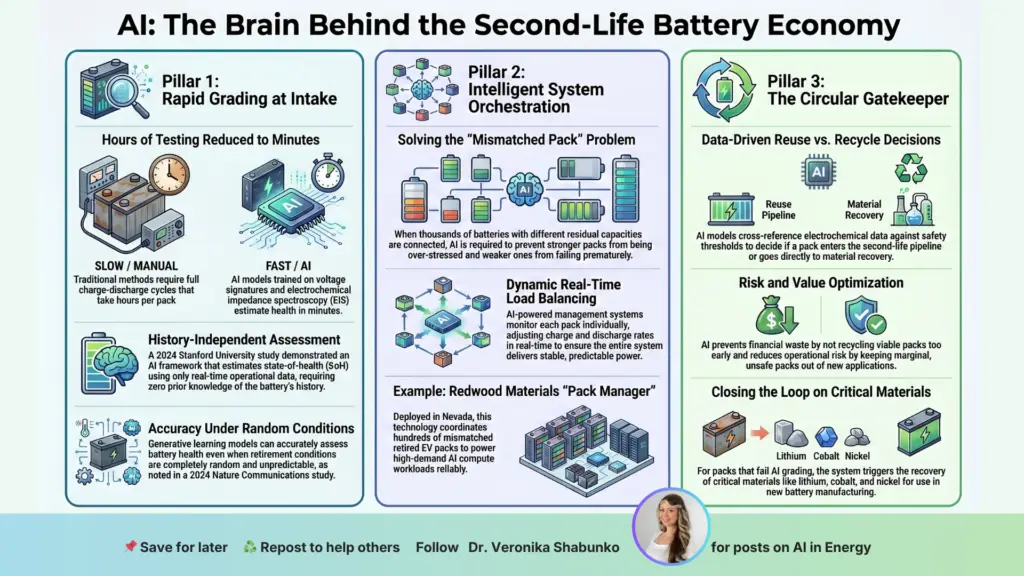
This is where AI enters. It does three things that no traditional battery management system can do alone.
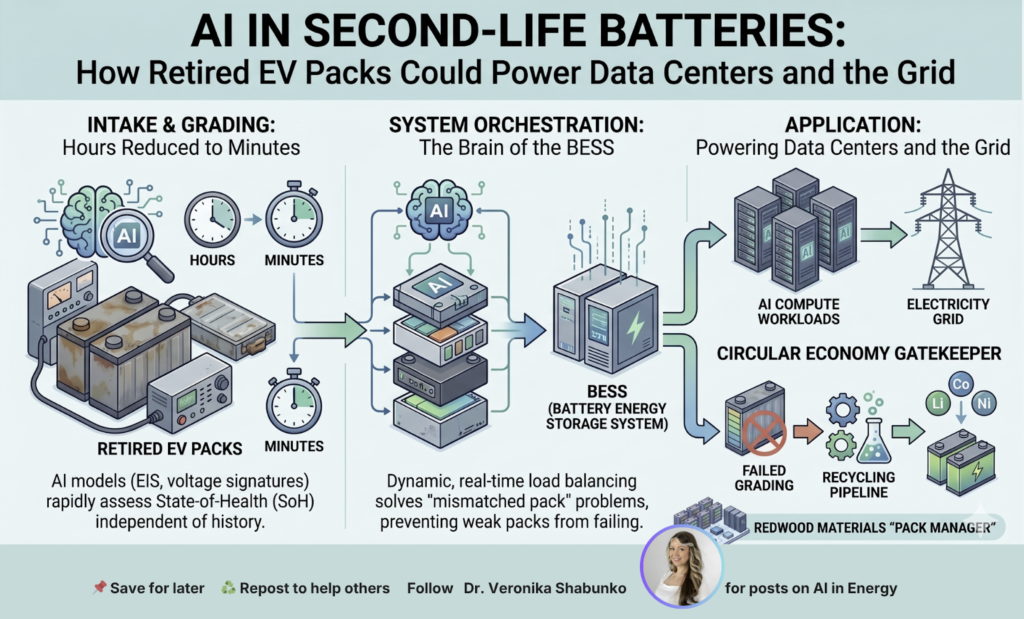
1. AI Grades Batteries at Intake
Before a retired battery pack can be reused, someone has to assess exactly how much life it has left.
Traditional testing methods are slow. They require full charge-discharge cycles, which can take hours per pack. At the scale of thousands of packs per month, that process becomes a bottleneck.
AI-powered grading changes this fundamentally. Machine learning models trained on electrochemical impedance spectroscopy (EIS) data, partial charge curves, and voltage signatures can estimate state of health in minutes, without a full cycle test.
An adaptive data-driven SoH estimation framework pioneered by Stanford University operates exclusively on real-time operational data, with no prior knowledge of a battery’s history required [4].
This pairs with generative learning models that can estimate battery SoH accurately even under random retirement conditions—precisely the variable, unpredictable intake scenario that second-life operators face daily [5].
The AI lens: AI grading turns a slow, expensive, pack-by-pack assessment process into a fast, scalable, data-driven decision engine. It determines, within minutes, whether a pack should be reused, in which application, and at what capacity rating.
The key lesson: Fast, accurate grading is the bottleneck that makes or breaks second-life economics at scale. AI solves it.
2. AI Matches and Orchestrates Mismatched Packs
Grading individual packs is only the first challenge. The second is assembling them into a system that delivers stable, predictable power, even though every pack in that system is slightly different.
This is the orchestration problem. And it is harder than it sounds.
When thousands of packs with varying residual capacities, internal resistances, and degradation profiles are connected together, they do not behave uniformly. Some discharge faster.
Some hold voltage better. If left unmanaged, stronger packs carry the load while weaker ones are over-stressed, accelerating degradation and reducing system life.
AI-powered battery management systems continuously monitor each pack’s behavior in real time.
They balance loads dynamically, adjust charge and discharge rates at the pack level, and predict which packs are approaching their safe operating limits before problems develop.
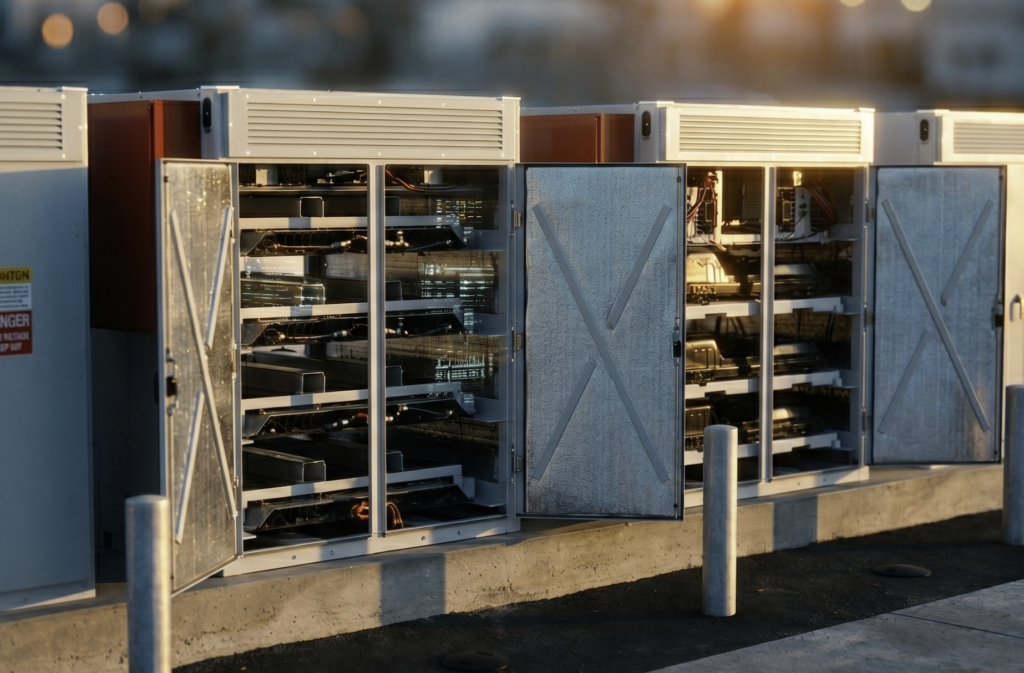
Redwood Materials’ proprietary “Pack Manager” technology, deployed in their Sparks, Nevada microgrid, handles exactly this orchestration challenge.
It coordinates hundreds of individual retired EV battery packs into a system capable of delivering steady, reliable power to some of the world’s most demanding AI compute workloads [6].
The AI lens: Pack-level orchestration is what converts a warehouse of mismatched retired batteries into a coherent, bankable energy storage asset.
Without it, second-life systems are unreliable. With it, they can compete directly with new battery installations.
The key lesson: AI orchestration is the difference between a pile of old batteries and a grid-ready storage system.
3. AI Decides When to Recycle
Not every retired battery is suitable for a second life. Some packs are too degraded. Others have fault histories that make reuse unsafe. AI makes that distinction quickly and accurately.
When a pack enters the assessment process, AI models cross-reference electrochemical data with safety thresholds, degradation signatures, and application requirements.
Packs that pass go into the second-life pipeline. Packs that fail go directly to recycling, where critical materials like lithium, cobalt, and nickel are recovered for new battery manufacturing.
This decision has significant financial and environmental consequences. Sending a viable pack to recycling prematurely wastes its remaining value. Sending a marginal pack into a safety-critical application creates operational risk.
AI makes that call consistently, at scale, without human bottlenecks.
The AI lens: AI is the gatekeeper of the circular battery economy. It decides the journey of every pack, reuse, redeploy, or recycle, based on real data, not conservative assumptions.
The key lesson: The reuse-or-recycle decision is not just environmental. It is financial. AI makes it faster and more accurately than any alternative.
Case Study: Redwood Materials + Crusoe — The World’s Largest Second-Life Battery Deployment
This is not a pilot project. It is the most significant proof point in the second-life battery industry to date.
What they built: In June 2025, Redwood Materials, founded by former Tesla CTO JB Straubel, launched a 12 MW / 63 MWh microgrid at its 100-acre campus in Sparks, Nevada. It is powered by a 20-acre solar array and hundreds of repurposed EV battery packs.
Redwood and Crusoe described it as the world’s largest second-life battery deployment and the largest battery-powered microgrid in North America at the time of announcement [6, 7].
Redwood’s Pack Manager system continuously monitors and orchestrates individual retired battery packs, helping the system balance uneven degradation, variable capacity, and pack-level performance differences.
Because each pack has a different degradation history, the AI dynamically balances load distribution, preventing any single pack from being overstressed while ensuring the system delivers steady power to AI compute loads that cannot tolerate interruption.
The microgrid operates entirely off-grid, powered by solar during the day and second-life batteries after sunset [6, 7].
Who it powers: The microgrid supplies Crusoe’s modular Spark™ data centers—GPU-dense units running high-performance processors for AI model training and inference.
Following the success of the initial installation, Crusoe and Redwood launched a massive 2026 expansion, scaling the site from 4 to 24 modular data center units, bringing the campus power demand up to 20 MW and multiplying compute density nearly sevenfold [8].
The proof: Since its initial commissioning, the off-grid solar and second-life battery system has maintained a highly stable 99.2% operational availability [8].
This consistency gave both companies the confidence to execute their massive 2026 infrastructure scale-up.
The system delivers electricity at prices below local grid rates.
Why it matters beyond Nevada: Redwood currently processes over 20 GWh of batteries annually — approximately 90% of all lithium-ion batteries recycled in North America, equivalent to 250,000 EVs per year [6].
The company already has over 1 GWh of reusable batteries in its deployment pipeline and is designing projects at 100 MW+ scale.
General Motors has also partnered with Redwood, with GM second-life battery packs now feeding the Sparks system [9].
The key lesson: Second-life batteries can power some of the world’s most demanding infrastructure, AI data centers, at lower cost than new systems, built in months rather than years. AI orchestration is what makes it possible.
The Hidden Bottleneck: Safety, Certification, and Bankability
Second-life batteries do not only need to work. They need to be trusted. That means developers must prove that reused packs can be safely tested, graded, integrated, and insured. Historically, scaling this has been held back by a rigid compliance bottleneck.
That bottleneck is officially breaking. In May 2026, Moment Energy secured a $40 million Series B funding round (bringing their total capital to over $100 million) to build a massive 200,000-square-foot battery-repurposing megafactory [10].
Why this matters comes down to compliance: Moment Energy became the first provider to achieve full certification across the strict UL safety stack (including UL 1973, UL 1974, and UL 9540A) [11].
By using automated testing and AI-driven diagnostics to meet these definitive benchmarks, they are proving that repurposed EV packs from automakers like Mercedes-Benz can be deployed directly into commercial built environments without regulatory loopholes.
In this mature phase of the market, the dominant players will not simply be the ones with the cheapest used batteries. They will be the companies utilizing AI to turn mismatched vehicle packs into certified, traceable, and bankable grid-scale assets.
What Most People Miss About Second-Life Batteries
Most energy professionals think about second-life batteries as a recycling story.
That misses the bigger point. This is a value creation story.
A retired EV battery that still holds 75% capacity is not waste. It is a storage asset that has already been manufactured, shipped, and paid for, one that can now serve the grid, a data centre, or a microgrid at a fraction of the cost of a new system.
Every month it spends in stationary storage is revenue and grid value that would otherwise be lost.
The professionals who understand this, and who understand that AI is what makes the economics work, are moving into a market with a 65% CAGR, limited competition, and a supply wave that is only just beginning.
The EV fleet that produced the first large wave of retirements is still young. The real volume arrives in the late 2020s.
The window is open now. The companies building second-life battery intelligence today, diagnostics, grading, orchestration, certification, and recycling pathways, may become the low-cost storage players of the 2030s.
Key Takeaways
-
Second-life EV batteries retain 70–80% capacity at retirement. They are not waste — they are underpriced storage assets.
-
The second-life battery market will grow from 25–30 GWh in 2025 to 330–350 GWh by 2030, at a 65% CAGR.
-
AI solves three problems new systems cannot: rapid SoH grading at intake, real-time orchestration of mismatched packs, and the reuse-or-recycle decision.
-
Redwood Materials + Crusoe have proven the model: 12 MW / 63 MWh, 99.2% uptime, electricity delivered below grid price, built in under four months.
-
The real volume of retired packs is still to come. The organizations building AI-enabled second-life infrastructure now will have a structural cost advantage through the 2030s.
FAQ: AI in Second-Life Battery
What are second-life batteries?
Second-life batteries are retired EV battery packs that still retain significant capacity, typically 70–80%, after they are no longer suitable for automotive use. They are repurposed for stationary applications such as grid storage, microgrids, and data center backup power.
How does AI help with second-life batteries?
AI performs rapid state-of-health grading at intake, dynamically orchestrates mismatched packs into stable storage systems, optimizes charge and discharge decisions in real time, and determines whether each pack should be reused or sent to recycling.
Are second-life batteries reliable enough for critical infrastructure?
The Redwood Materials + Crusoe deployment at Sparks, Nevada, achieved 99.2% operational availability over seven months while powering GPU-dense AI data centers. That figure demonstrates commercial-grade reliability in a demanding application.
What happens after second-life use?
After the second life is complete, batteries enter recycling, where critical materials, including lithium, cobalt, and nickel, are recovered for new battery manufacturing. This closes the circular economy loop.
References
[1] International Energy Agency, “Close to 30% of cars sold this year are set to be electric as countries and consumers respond to energy crisis,” IEA, May 2026. [Online]. Available: https://www.iea.org/news/close-to-30-of-cars-sold-this-year-are-set-to-be-electric-as-countries-and-consumers-respond-to-energy-crisis
[2] MarketsandMarkets, “Second Life EV Battery Market worth 330–350 GWH by 2030,” MarketsandMarkets, Aug. 2025. [Online]. Available: https://www.marketsandmarkets.com/PressReleases/second-life-ev-battery.asp
[3] E. Martinez-Laserna et al., “A Review of the Technical Challenges and Solutions in Maximizing the Potential Use of Second Life Batteries from Electric Vehicles,” Batteries, vol. 10, no. 3, p. 79, Feb. 2024, doi: 10.3390/batteries10030079.
[4] X. Cui, M. A. Khan, S. Singh, R. Sharma, and S. Onori, “Towards a BMS₂ Design Framework: Adaptive Data-driven State-of-health Estimation for Second-Life Batteries with BIBO Stability Guarantees,” presented at the 2024 American Control Conference, Toronto, Canada, Jul. 2024. [Online]. Available: https://arxiv.org/abs/2401.04734
[5] Y. Che et al., “Generative learning assisted state-of-health estimation for sustainable battery recycling with random retirement conditions,” Nature Communications, vol. 15, Nov. 2024, doi: 10.1038/s41467-024-54454-0.
[6] Crusoe and Redwood Materials, “Crusoe and Redwood Materials Unveil World’s Largest Second-Life Battery Deployment,” Crusoe.ai, Jun. 2025. [Online]. Available: https://www.crusoe.ai/resources/newsroom/crusoe-and-redwood-materials-power-the-future-of-ai
[7] T. Rayner, “Redwood, Crusoe Deploy Second-Life Batteries at AI Data Center for 63 MWh Storage,” Energy Storage News, Jun. 2025. [Online]. Available: https://www.ess-news.com/2025/06/27/redwood-crusoe-deploy-second-life-batteries-at-data-center-for-63-mwh-storage/
[8] HPCwire, “Crusoe and Redwood Materials Expand AI Data Center Deployment to 24 Modular Units in Nevada,” HPCwire, Mar. 2026. [Online]. Available: https://www.hpcwire.com/off-the-wire/crusoe-and-redwood-materials-expand-ai-data-center-deployment-to-24-modular-units-in-nevada/
[9] Data Centre Magazine, “GM and Redwood Target Battery Storage for Data Centres,” Data Centre Magazine, Jul. 2025. [Online]. Available: https://datacentremagazine.com/news/gm-and-redwood-target-battery-storage-for-data-centres
[10] Moment Energy, “Moment Energy secures $40M Series B to scale North America’s largest second-life battery platform,” Moment Energy Inc., Austin, TX, USA, Press Release, May 5, 2026. [Online]. Available: https://www.momentenergy.com/news/series-b
[11] Moment Energy, “Moment Energy to build world’s largest battery repurposing ‘megafactory’ in Vancouver in 6 weeks,” PR Newswire, Vancouver, BC, Canada, News Release, May 13, 2026. [Online]. Available: https://www.prnewswire.com/news-releases/moment-energy-to-build-worlds-largest-battery-repurposing-megafactory-in-vancouver-in-6-weeks-302771063.html
[12] Roots Analysis, “Global Second Life EV Battery Market Share and Analysis: 2026-2040,” Roots Analysis, Sector Report, May 2026. [Online]. Available: https://www.rootsanalysis.com/reports/second-life-ev-battery-market.html
[13] Crusoe and Redwood Materials, “Crusoe and Redwood Materials expand strategic partnership, scaling to 7x the original AI infrastructure density,” GlobeNewswire, San Francisco, CA, USA, News Release, Mar. 24, 2026. [Online]. Available: https://www.globenewswire.com/news-release/2026/03/24/crusoe-redwood-expand-strategic-partnership