Artificial intelligence is changing how energy is generated, stored, managed, and sold. But understanding AI in Energy has become surprisingly difficult, even for people who have spent their careers in the industry.
Hundreds of research papers on battery optimization, utility announcements about intelligent grids, startups promising autonomous energy systems, and new developments in Virtual Power Plants (VPPs) flood the field. Add AI-powered solar forecasting, wind-turbine analytics, digital twins, and the enormous electricity requirements of AI data centers, and the field quickly becomes difficult to follow.
The challenge is no longer finding information. It is understanding which applications matter, how they create value, how commercially mature they are, and where the real opportunities lie.
That is exactly what The Intelligence Layer: How AI Is Rewiring the Global Energy Transition, by Dr. Veronika Shabunko and Academician Seeram Ramakrishna, was written to address.
Rather than examining one technology in isolation, the book maps 62 AI applications across six major energy technology areas, connects them to operational and commercial value, and explains how the different parts of the energy system are beginning to work together.
For professionals who need to understand the changing industry without spending months assembling fragmented research, it provides something increasingly valuable: one connected view of AI in Energy.
What Is AI in Energy, and Why Does It Matter?

AI in Energy refers to the use of artificial intelligence, machine learning, predictive analytics, digital twins and optimization technologies to improve decisions across energy generation, storage, transmission, distribution and consumption.
In solar energy, AI can forecast generation, detect faults and improve asset operation. In battery energy storage systems, it can help determine when to charge, discharge or participate in electricity markets. In Virtual Power Plants, it can coordinate thousands of distributed devices so they function as a reliable energy resource.
In smart grids, AI can improve load forecasting, fault detection, asset monitoring and network planning.
The important insight is that these applications share a common purpose: turning operational data into better decisions.
That purpose is easy to overlook when every vendor describes its technology as revolutionary.
An algorithm has little commercial value merely because it is sophisticated. Its value comes from the decision it improves, the cost it avoids, the revenue it enables or the risk it helps manage.
This is the central economic idea explored throughout The Intelligence Layer.
The Intelligence Premium: Why Identical Energy Assets Can Produce Different Results
Consider two battery storage projects with comparable hardware, capacity and access to the same electricity market.
One follows conventional operating strategies. The other uses advanced forecasting and optimization to coordinate dispatch, electricity prices, battery degradation and market opportunities.
The physical assets may be nearly identical, but their operating outcomes can differ.
The book calls this difference the Intelligence Premium: the measurable improvement in revenue, cost, reliability, safety or asset life attributable to better intelligence.
The same principle applies across solar, wind, grids and distributed energy systems.
It changes the question an executive or investor should ask. Instead of simply asking whether an energy asset uses AI, the more useful question is:
Where is value being lost because the decision is not intelligent enough?
That single question provides a practical starting point for evaluating almost any AI application in energy.
How Is AI Used in Solar Energy?
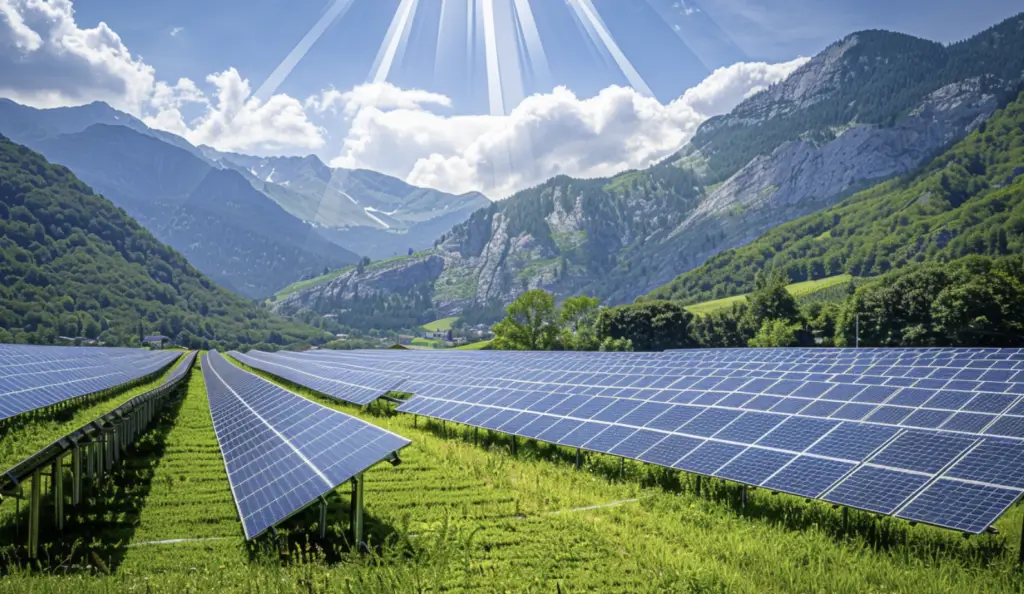
Solar energy is no longer only about producing electricity at the lowest possible cost. Increasingly, operators must also forecast when electricity will be available, manage unexpected equipment behavior, respond to curtailment and coordinate generation with storage and market conditions.
AI can improve these decisions through weather-integrated forecasting, automated fault detection, predictive maintenance and intelligent control.
For example, better solar forecasting can help an operator anticipate changes in output and prepare storage or market positions accordingly. AI-assisted fault detection can identify abnormal inverter or string behavior before a problem leads to substantial production losses.
But there are also less obvious applications. Intelligent soiling analysis can help determine when cleaning is economically justified. AI-supported permitting and interconnection analysis may improve project-development workflows.
Inside Chapter 3 of The Intelligence Layer, readers explore 11 solar AI applications, including irradiance forecasting, autonomous tracker optimization, fault detection, soiling management, energy trading and other emerging uses.
Each application is connected to its operating problem, potential business value and deployment maturity, helping readers understand not only what AI can do but where further evaluation is justified.
How Is AI Used in Wind Energy?

Wind energy creates a different set of challenges. Turbines operate in changing weather conditions, equipment is exposed to mechanical stress, and maintenance can be especially costly at remote or offshore installations.
AI applications in wind range from predictive maintenance and blade inspection to wake steering, weather forecasting and advanced turbine control.
Wake steering is particularly interesting because optimizing one turbine individually does not necessarily optimize an entire wind farm. Adjusting the operation of an upstream turbine can sometimes improve the combined performance of turbines farther downstream.
This illustrates an important shift from optimizing individual machines to optimizing the system as a whole.
Chapter 4 of The Intelligence Layer maps 10 AI applications in wind energy, including turbine control, structural health monitoring, drone-based inspection, wind-plus-storage optimization and emerging applications in floating offshore wind.
Readers see how these technologies relate to generation yield, maintenance expenditure, structural fatigue and long-term asset performance.
How Does AI Improve BESS Optimization?

Battery Energy Storage Systems are among the clearest examples of why intelligent decisions matter.
A battery can charge when electricity is inexpensive, discharge when prices rise, provide grid services and support renewable integration. However, every operating decision must account for physical constraints, battery health and future opportunities.
This makes BESS optimization much more complex than simply buying electricity low and selling it high.
AI-assisted systems can evaluate electricity-market signals, state of charge, state of health, degradation, dispatch constraints and potential revenue opportunities. Predictive analytics can also help detect developing safety or equipment problems.
For investors and asset owners, the important issue is how these capabilities affect lifetime economics, not merely short-term trading results.
Chapter 5 covers 10 AI applications in BESS, from battery safety analytics, degradation prediction and autonomous energy trading to fleet analytics, second-life battery management and AI-assisted project design.
The chapter helps readers connect battery intelligence to the questions that determine commercial performance: how assets earn revenue, how they age, how operational risk is managed and where software can genuinely improve the investment case.
How Is AI Used in Virtual Power Plants (VPPs)?
Virtual Power Plants are one of the most important examples of intelligence creating value through coordination.
A VPP combines distributed resources such as residential batteries, rooftop solar, electric vehicles, smart thermostats and flexible commercial loads into a coordinated portfolio.
These assets may belong to thousands of different owners, operate under different constraints and respond to different local conditions.
The challenge is making them behave collectively like a dependable grid resource.
AI can help forecast resource availability, optimize dispatch, coordinate demand response, support market bidding and verify whether committed flexibility was actually delivered.
A VPP must do more than send instructions to devices. It needs to understand which devices are available, what each can contribute and whether the resulting performance can be measured reliably.
That makes VPPs both an energy coordination problem and an information problem.
Chapter 6 of The Intelligence Layer examines nine AI applications in Virtual Power Plants, including distributed energy resource aggregation, flexible-load orchestration, multi-timescale forecasting, autonomous market bidding, measurement and verification, EV fleet coordination and data-center flexibility.
For utility professionals, aggregators, investors and energy technology founders, this creates a practical way to understand the economics and operating requirements behind the VPP business model.
What Is Grid AI and How Is It Transforming Electricity Networks?

Grid AI describes the use of artificial intelligence and advanced analytics to improve electricity-network planning, monitoring and operations.
As renewable generation, distributed batteries and large new loads become more common, electricity networks must manage increasingly complex combinations of demand, generation and system constraints.
AI can support net-load forecasting, network-state estimation, fault detection, congestion management, predictive maintenance and grid-capacity analysis.
But one of the most valuable lessons is understanding the limits of intelligence.
Software cannot create a transmission line that has not been built. An algorithm cannot eliminate every physical constraint. And critical electricity infrastructure requires validation, cybersecurity, engineering safeguards and appropriate human accountability.
The opportunity is to determine where better information makes existing infrastructure more useful, more reliable or easier to operate.
Chapter 7 maps 11 Smart Grid AI applications, ranging from load forecasting and fault localization to dynamic line rating, distribution-network visibility, grid digital twins and automated network reconfiguration.
It gives readers a framework for identifying which problems intelligence can help solve, and which still require investment in physical infrastructure.
AI Data Center Power and Frontier Energy Technologies

The AI-energy relationship has a paradox at its center: artificial intelligence needs electricity, while electricity systems increasingly use AI to improve their performance.
The growth of AI data centers is creating new requirements for generation, transmission, storage, grid connections and reliable power supply. At the same time, certain data-center workloads, cooling systems and onsite batteries may offer flexibility under suitable operating conditions.
This connection is only one part of a much broader emerging landscape.
AI is also being applied to hydrogen production, nuclear operations, geothermal exploration, carbon capture, industrial processes and energy robotics.
These opportunities are not equally mature, and they should not be evaluated as though they are.
Chapter 8 examines 11 AI applications across frontier energy technologies, explaining their potential value, operational limitations and different levels of commercialization.
Together with the preceding technology chapters, it completes the book’s 62-application map of AI in Energy.
Inside The Intelligence Layer: 62 AI Applications, Six Technology Areas, One Connected Framework

Most resources on AI in Energy concentrate on one technology or one part of the value chain.
The Intelligence Layer takes a broader approach. It brings the major technology categories into one structured framework, so readers can see the opportunities within each field and understand how they connect.
The book’s six application maps cover:
| Energy technology | Applications explored | Examples of what readers learn |
|---|---|---|
| Solar energy | 11 | Forecasting, tracker optimization, fault detection, soiling management and market participation |
| Wind energy | 10 | Wake steering, turbine control, maintenance, drone inspection and wind-storage coordination |
| BESS | 10 | Safety analytics, battery health, dispatch optimization, revenue stacking and fleet management |
| Virtual Power Plants | 9 | DER aggregation, demand response, market bidding, verification and EV orchestration |
| Smart grids | 11 | Load forecasting, fault localization, dynamic line rating, congestion management and digital twins |
| Frontier technologies | 11 |
Hydrogen and industrial fuels, nuclear, geothermal, carbon capture, CO₂ storage, direct air capture, long-duration storage and materials discovery |
| Total | 62 | A connected view of the AI-energy application landscape |
Explore The Intelligence Layer and the Founding 100 Bundle →
Read the Opening Chapter Free →
The value is not simply the number of applications.
Each technology chapter moves beyond definitions to explain the operating challenge, how AI can be used, where business value may arise, the available evidence, and the risks that still need attention.
Each application map identifies the technologies, their potential business value and their commercial maturity. Chapters 3–7 organize applications into tiers, while Chapter 8 groups frontier technologies by sector to reflect their different stages of commercialization.
Instead of learning 62 disconnected technologies, readers learn how to evaluate them using a consistent set of questions.
That is what makes the book a practical reference rather than another collection of AI predictions.
What Will You Actually Learn From the Book?
The book contains 10 chapters across four parts, designed to take the reader from understanding the underlying problem to applying the insights in business, operational and investment decisions.
Part I: Why Energy Needs an Intelligence Layer introduces the coordination challenges facing modern energy systems and explains the capabilities behind intelligent operations. Readers develop a working understanding of machine learning, deep learning, reinforcement learning, digital twins, generative AI, data requirements and the difference between optimization, prediction and autonomy.
Part II: Where Intelligence Creates Value is the six-technology application map. It covers solar, wind, BESS, VPPs, smart grids and frontier technologies, connecting each field to documented applications, business value, operating risks and commercial maturity.
Part III: When Everything Connects brings the separate technologies together. Chapter 9 examines convergence: how solar, batteries, distributed resources, electricity networks and large flexible loads are becoming increasingly interdependent.
Part IV: The New Competitive Landscape examines where business value may shift as better data, intelligent workflows and advanced coordination become more important. It helps readers consider what this means for incumbents, technology providers, investors and emerging companies.
The final appendices make the learning more practical. Appendix A provides a 2026 AI-energy startup reference, while Appendix B includes a seven-step AI-in-energy evaluation workflow, a worked solar-curtailment example, prompt templates and a checklist for reviewing AI-generated outputs.
The objective is not to make every reader an AI developer. It is to develop the ability to understand an application, ask the right questions and evaluate its relevance to a real energy decision.
The Transformation: From Following AI Headlines to Evaluating AI Opportunities
There is a familiar experience among professionals working in rapidly changing industries.
You understand your own field. You have years of technical, commercial or strategic experience. But a growing number of meetings now involve technologies, companies and terminology that sit just beyond your immediate expertise.
An investor discusses AI-driven battery trading. A utility team evaluates a VPP platform. A vendor presents an intelligent grid-management system. A developer proposes a new data-center power strategy.
You recognize the opportunity, but understanding the full implications requires knowledge from several different disciplines.
That is the gap this book is designed to close.
After studying the framework, readers should be better prepared to understand what a proposed AI application actually does, which data and infrastructure it requires, how to assess commercial claims and where technical limitations may undermine the business case.
They learn to translate AI performance into five practical value categories: yield, operating cost, revenue, asset life and capital cost.
They also learn to ask whether the comparison uses a credible baseline, whether the improvement is measurable under real operating conditions and what safeguards are required before implementation.
Consider how that changes a vendor discussion.
Instead of being impressed by a claimed improvement in forecasting accuracy, you can ask how that improvement affects dispatch, balancing costs or revenue.
Instead of accepting a VPP’s advertised capacity, you can ask how availability and delivered flexibility are verified.
Instead of assuming AI will improve a battery investment, you can ask how its optimization strategy accounts for degradation, warranties and changing market conditions.
You become harder to impress with the words “AI-powered”—and better equipped to recognize when the technology actually matters.
That is a far more useful outcome than simply knowing additional terminology.
Why the Founding 100 Bundle Makes This a One-Stop AI in Energy Learning System
A book can give you a strong framework. But professionals navigating the AI-energy industry also need practical terminology, an understanding of which companies are active and a way to interpret recent market developments.
That is why the Founding 100 Launch Bundle brings together four complementary resources.
The book gives you the framework. Its 10 chapters and 62 mapped applications explain the technologies, operating logic, value creation and risks.
The AI in Energy Fluency Guide gives you the language. With 100 essential terms explained in plain English, along with questions those terms can unlock in professional meetings, it helps readers move more comfortably between technical, strategic and investment discussions.
The AI-Energy 100 Watchlist gives you the market map. Covering 100 companies across areas including data-center power, storage, VPPs, grid intelligence, solar, wind, robotics and firm power, it provides a starting point for understanding who is developing technologies across the ecosystem.
The Q3 2026 AI in Energy Intelligence Report gives you the market signals. Its ten evidence-led developments help connect the book’s broader frameworks to changes affecting power grids, batteries, flexible data centers and energy markets during that period.
These resources work together because the problem is not merely learning what AI means.
It is being able to move from understanding a technology to understanding its applications, companies, business implications and market context.
You could assemble much of that knowledge independently by reading papers, building a glossary, researching companies and organizing industry reports.
There is nothing wrong with doing that.
The question is whether assembling the information from scratch is the best use of your time.
The bundle provides a more structured starting point, combining strategic understanding with resources you can refer to when preparing for meetings, researching a company or evaluating a proposed AI-energy application.
What’s Included in the Founding 100 Launch Bundle?
| Resource | Individual value |
|---|---|
| The Intelligence Layer — Digital eBook | US$34.99 |
| AI in Energy Fluency Guide — 100 Terms | US$29.00 |
| AI-Energy 100 Watchlist — 100 Companies | US$79.00 |
| Q3 2026 AI in Energy Intelligence Report | Included free |
| Combined individual value | US$142.99 |
| Founding 100 bundle price | US$12.99 |
Save US$130 with the Founding 100 offer, available for the first 100 completed purchases.
Get the Complete AI in Energy Bundle for US$12.99 →
See How the Intelligence Layer Begins — Read the Opening Chapter Free
Before committing to the full book, explore the Preface and Chapter 1, “The Grid That Cannot Think.”
Discover why the energy transition is becoming a coordination problem, what the growing Intelligence Gap means, and why the value of energy infrastructure increasingly depends on the quality of decisions made around it.
Read the Preface and Opening Chapter Free →
Who Should Read The Intelligence Layer?
This book is intended for people whose work, investments, or career decisions increasingly intersect with AI and energy.
For energy executives and utility managers, it offers a structured way to understand applications, question technology proposals, and identify where intelligence may improve operations.
For investors and venture capital professionals, it provides a framework for examining the difference between a compelling AI narrative and a business model supported by measurable operational value.
For energy technology founders, it offers a broader understanding of customer problems, competing approaches, market maturity and the decision-making requirements of energy organizations.
For engineers and grid professionals, it connects existing technical expertise to the expanding landscape of AI applications and business implications.
And for students and professionals entering the field, it provides a coherent starting point for understanding an industry that crosses several traditionally separate disciplines.
No programming or machine-learning background is required. The emphasis is on understanding what AI does, where it fits, how it creates value and what should be verified before it is trusted.
About the Authors
Dr. Veronika Shabunko is an international energy strategist and researcher with more than 12 years of experience across renewable energy, distributed energy resources and grid innovation in Canada and internationally. Her background includes leadership at the Solar Energy Research Institute of Singapore (SERIS), National University of Singapore, contributions to Singapore’s Solar PV Roadmap, and more than 30 scholarly and technical publications.
Prof. Seeram Ramakrishna is a Xinghua Distinguished Chair Professor at Tsinghua University and a Top 1% Highly Cited Researcher worldwide (Stanford / Elsevier list). His career includes senior leadership roles at the National University of Singapore and work at Tsinghua University, with extensive contributions to engineering, materials, research, and technological innovation.
Their combined perspectives bring together energy-system knowledge, applied research, strategic development, and engineering expertise.
Frequently Asked Questions About AI in Energy and The Intelligence Layer
What are the main applications of AI in Energy?
Major AI applications in energy include solar and wind forecasting, predictive maintenance, BESS optimization, autonomous energy trading, Virtual Power Plant coordination, grid monitoring, digital twins, fault detection, demand response, and data-center energy management. The Intelligence Layer maps 62 applications across six major energy technology areas.
How can AI improve Battery Energy Storage Systems?
AI can help BESS operators improve charge-discharge scheduling, battery health monitoring, market participation, revenue stacking, predictive maintenance and safety analytics. The economic value depends on the application’s ability to improve operational outcomes while accounting for degradation, constraints and market conditions.
How does AI work in Virtual Power Plants?
AI helps VPPs coordinate distributed resources such as batteries, EV chargers, rooftop solar and flexible demand. It supports forecasting, resource aggregation, dispatch, market participation and verification of delivered flexibility. The Intelligence Layer explores nine applications specifically related to VPPs.
What does The Intelligence Layer teach that free AI articles do not?
Individual articles often cover one application or technology. The Intelligence Layer offers a connected framework across six energy technology areas, with 62 mapped applications, business-value analysis, evidence and maturity discussions, risks, real-world cases and practical evaluation workflows. Its purpose is to help readers develop a coherent understanding rather than collect isolated facts.
Is The Intelligence Layer suitable for business executives and investors?
Yes. The book is designed for professionals who need to understand the implications of AI in energy without becoming machine-learning engineers. It emphasizes economic value, commercial maturity, practical applications, implementation requirements and better decision-making.
What is the AI-Energy 100 Watchlist?
The AI-Energy 100 Watchlist is a companion resource mapping 100 companies operating across AI-related areas of the energy industry, including storage, VPPs, smart grids, solar, wind, robotics, firm power and data-center infrastructure. It is intended to support market orientation and further research, not to replace investment due diligence.
What is included in the Founding 100 Launch Bundle?
The bundle includes The Intelligence Layer eBook, the AI in Energy Fluency Guide, the AI-Energy 100 Watchlist and the Q3 2026 AI in Energy Intelligence Report. The combined individual value is US$142.99, while the Founding 100 offer provides the four digital resources for US$12.99 to the first 100 completed purchasers.
One Book to Understand Where AI in Energy Is Going—and What It Means for You
AI in Energy is not one technology, one market or one isolated opportunity.
It is changing the operating logic of solar farms, wind projects, batteries, virtual power plants, electricity networks and emerging energy infrastructure. Understanding what is happening requires more than familiarity with individual algorithms or headlines.
It requires the ability to see how technology, physical assets, markets and intelligent decisions fit together.
That is what The Intelligence Layer is designed to provide.
With 10 chapters, 62 mapped AI applications, practical evaluation frameworks and an integrated view of the energy industry, it gives readers a structured route through a field that is otherwise easy to experience as disconnected and overwhelming.
And with the Founding 100 bundle, you also receive the terminology, company landscape and Q3 2026 market analysis to extend that understanding beyond the book.
You do not need to learn every machine-learning algorithm.
You do not need to become an expert in every energy technology.
But if your work or future depends on understanding where AI is creating value in energy, you need a reliable way to separate meaningful developments from noise.
Start with the framework. Learn the applications. Understand the market. Know what to ask next.
Founding 100 Launch Bundle: US$12.99 instead of US$142.99 in individual resource value.
Available for the first 100 completed purchases.
Get The Intelligence Layer + All 3 Bonuses for US$12.99 →
Read the Opening Chapter Free →