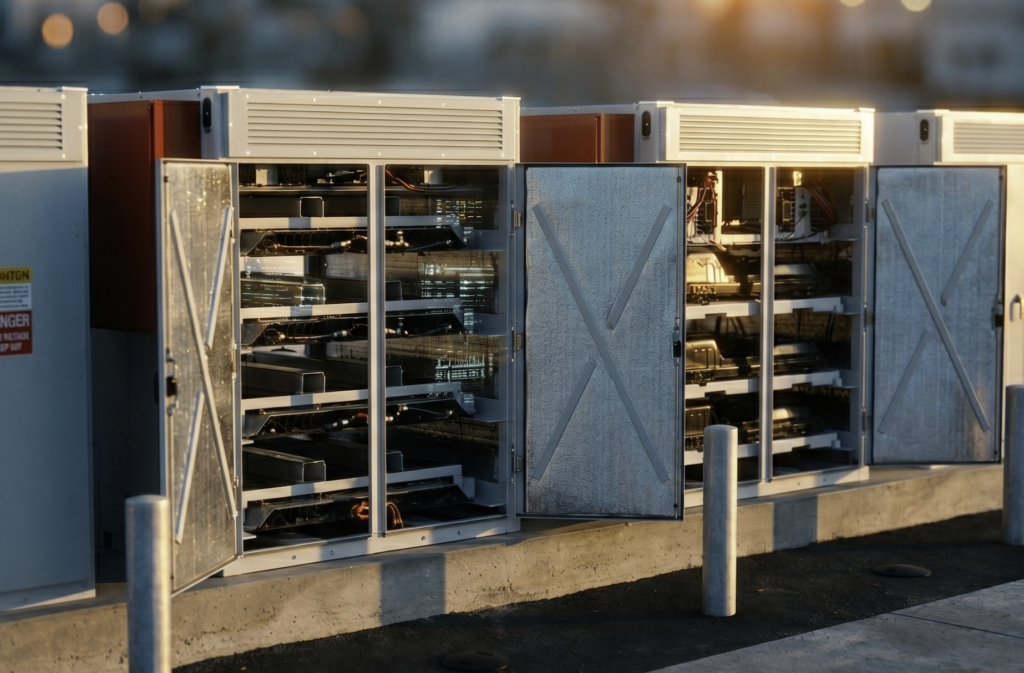
Battery energy storage is no longer just about hardware.
The real value is shifting to software.
Artificial intelligence is turning battery energy storage systems, or BESS, into intelligent grid assets. These systems can forecast demand, optimize charging, protect battery health, support the grid, and improve project economics.
That matters because the storage market is growing fast.
This shift matters because the world needs far more storage. According to the IEA’s Batteries and Secure Energy Transitions report, total battery capacity is projected to reach roughly 1,200 GW by 2030 in the Net Zero Emissions (NZE) scenario, representing a sixfold increase from 2023 levels [1]. That is not just a hardware challenge. It is an intelligence challenge.
We need more than just batteries.
We need smarter batteries.
What Is AI in Battery Energy Storage Systems?
AI in battery energy storage systems involves using data, machine learning, forecasting, and optimization algorithms to improve battery performance.
A traditional battery stores and releases electricity.
An AI-managed battery does much more. It can forecast electricity prices, predict solar and wind generation, monitor battery health, detect abnormal behavior, and decide when to charge, discharge, or reserve capacity for grid services.
This matters because battery value depends on timing. Charging at the wrong time can reduce revenue. Discharging too early can miss a better market opportunity. Operating too aggressively can shorten battery life. Missing an early fault can create safety and reliability risks.
AI helps balance these decisions in real time.
That is why AI in BESS is becoming one of the most important software layers in the energy transition. It connects the physical battery to the economic, technical, and operational signals around it.
Why AI Matters for BESS Now
Battery storage is growing as the power system becomes more variable, more distributed, and more complex.
Solar and wind are expanding quickly, but their output changes with the weather and the time of day. Electricity prices are becoming more volatile in many markets. Grid operators need faster flexibility. Industrial users want to reduce peak demand charges. Data centers and critical facilities need more resilient backup power.
Battery energy storage systems can help solve these challenges, but only if they are operated well.
A battery that charges during the wrong price window loses value. A battery that discharges too early may not be available when the grid needs it most. A battery that cycles too aggressively may degrade faster than expected. A battery that misses early thermal or cell-level warning signs can become a safety risk.
This is why the next generation of BESS economics will not be defined by hardware alone. It will depend on the intelligence that controls the asset.
How AI Is Transforming BESS: Predict, Optimize, Respond, Protect
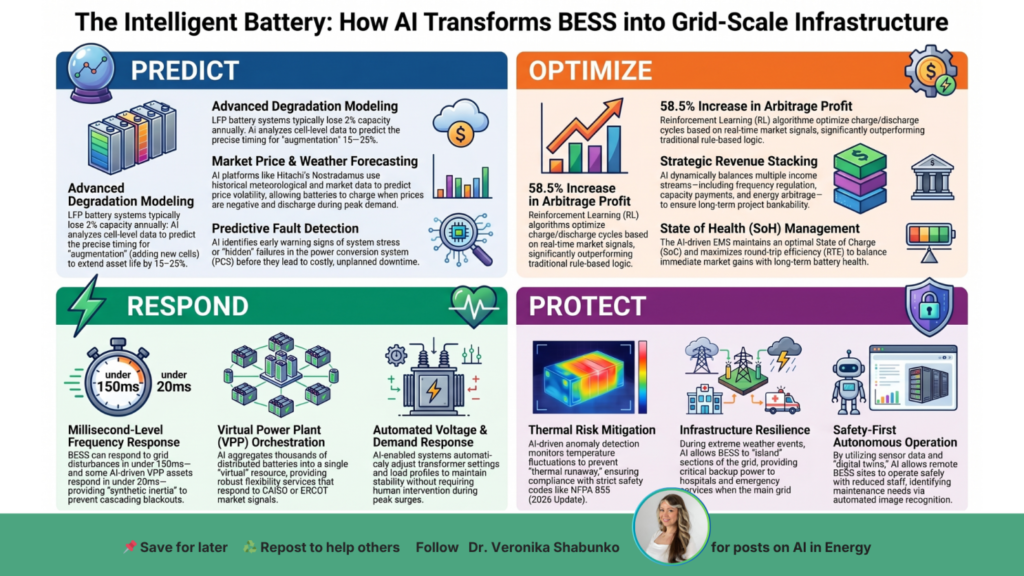
AI in battery energy storage systems is not one single function. It is a decision-making layer that helps BESS forecast market conditions, optimize battery dispatch, respond to grid events, and protect battery health.
The easiest way to understand AI in BESS is through four functions: predict, optimize, respond, and protect. Together, these functions transform battery storage from a passive energy asset into an intelligent grid-flexibility resource.
1. Predict: AI Helps BESS See What Comes Next
A battery cannot make good decisions if it only reacts to what is happening now. It needs to understand what is likely to happen next.
AI helps BESS forecast key signals, including electricity prices, renewable generation, site load, grid congestion, state of charge, and battery health. These forecasts allow the system to prepare before market or grid conditions change.
For example, if solar output is expected to rise sharply at midday, the battery may reserve capacity to absorb low-cost or surplus energy. If evening prices are expected to spike, the system may hold energy for a higher-value discharge window. If demand charges are likely to increase during a facility’s peak load period, the BESS can prepare for peak shaving.
This predictive layer is important because the BESS value is forward-looking. The best decision is rarely based only on the current price or current state of charge. It depends on what is likely to happen over the next few minutes, hours, or days.
In a volatile power market, the most valuable battery is not always the biggest one. It is often the one that can see the next move first.
2. Optimize: AI Improves Battery Dispatch and BESS Revenue Optimization
Optimization is where AI directly affects the economics of battery storage.
A BESS can create value in several ways: energy arbitrage, peak shaving, ancillary services, demand response, capacity markets, renewable smoothing, and backup power. The challenge is that these opportunities often compete with each other.
Should the battery discharge now to reduce a peak in demand? Should it wait for a higher market price later? Should it reserve capacity for frequency regulation? Should it reduce cycling to protect long-term battery health?
AI helps compare these options and choose the best action based on market signals, battery condition, site demand, and operating constraints.
EPRI notes that AI-based approaches can support energy storage applications such as energy arbitrage, frequency regulation, reserves, and load following [2]. This is important because modern BESS projects increasingly depend on revenue stacking. A battery may need to serve multiple value streams, not just one.
In BESS, timing is money. But timing is also risky. AI helps operators make better trade-offs between revenue, reliability, degradation, and system availability.
This is the heart of battery dispatch optimization.

3. Respond: AI Helps BESS Deliver Faster Grid Services
Battery energy storage systems can respond much faster than many traditional power assets. This makes them valuable for services such as frequency regulation, voltage support, reserves, and grid balancing.
NREL notes that for services such as frequency regulation, the speed and accuracy of response can be linked to the value of the service, and battery systems can provide some services faster and more accurately than conventional resources [3].
AI strengthens this capability by helping the battery decide how to respond under changing grid conditions. It can adjust dispatch, manage state of charge, coordinate with renewable generation, and support real-time control strategies.
This matters because power systems are becoming more dynamic. More renewable generation means more variability. More electrification means higher and less predictable demand. More distributed energy resources mean more coordination challenges.
BESS can act quickly, but AI helps it act intelligently.
That is why response speed is becoming a new form of value in power systems. A battery that can respond in milliseconds is useful. A battery that can respond in milliseconds while protecting revenue, safety, and long-term asset health is even more valuable.
4. Protect: AI Improves Battery Safety, Reliability, and Predictive Maintenance
Battery storage is not only an economic asset. It is also a safety-critical and reliability-critical system.
AI can help monitor temperature anomalies, cell imbalance, abnormal degradation, battery management system errors, unexpected charging patterns, and early fault signals. Instead of waiting for alarms after a problem becomes visible, AI can help detect patterns that suggest something is starting to go wrong.
This is especially important for critical infrastructure.
For data centers, hospitals, factories, and industrial sites, battery storage is not only about energy savings. It is part of operational resilience. When power fails, the cost is not only measured in electricity prices. It can be measured in downtime, lost production, lost data, and reputational damage.
Uptime Institute reported that for the second consecutive year, 54% of respondents said their most recent significant data center outage cost more than $100,000, and about one in five cost more than $1 million [4].
This is where AI-managed BESS becomes more than an energy tool. It becomes a risk management tool.
When the grid is stable, AI can optimize cost and revenue. When the grid becomes unstable, AI can help protect continuity.
3 Real-World Case Studies of AI in BESS
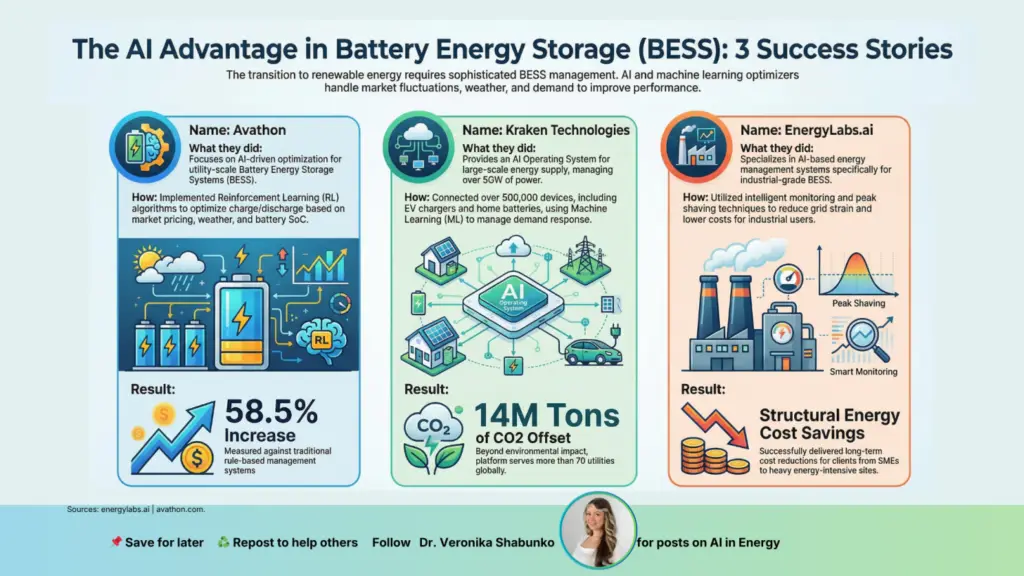
AI in battery energy storage is not just a future idea. It is already appearing in commercial platforms, grid flexibility systems, and industrial energy management solutions.
Here are three examples that show how AI is changing the way BESS is operated.
Case Study 1: Avathon — AI for BESS Performance Optimization
Avathon provides industrial AI software for battery energy storage operators. Its platform is designed to improve efficiency, reduce operating costs, and increase profitability for BESS operators in fast-changing energy markets [5].
The AI lens here is performance optimization. Instead of relying only on static rules, an AI-enabled platform can use data from the battery, market, and operating environment to improve decisions over time.
For a BESS owner, this matters because small dispatch improvements can have a large financial impact across thousands of cycles. AI can help determine when the asset should charge, discharge, remain available, or reduce battery stress.
The key lesson from Avathon is simple: AI can shift BESS from passive operation to active performance management.
Case Study 2: Kraken Technologies — AI-Managed Distributed Flexibility
Kraken Technologies operates an AI-powered platform for utilities and distributed energy resources. Its distributed energy resource optimization solution includes electric vehicles, chargers, heat pumps, smart thermostats, and home batteries [6].
This case study shows that BESS is not always a single, large-battery project. Increasingly, batteries are part of a wider network of flexible assets.
A home battery, an EV charger, and a heat pump may look small on their own. But when thousands of devices are coordinated, they can become a valuable source of flexibility for the grid.
The AI lens is orchestration. Kraken’s model shows how software can coordinate distributed assets to support customers, utilities, and the grid simultaneously.
The key lesson is that AI can turn many small, flexible assets into one coordinated energy resource.
Case Study 3: EnergyLabs.ai — AI for Industrial Battery Optimization
EnergyLabs.ai focuses on smart battery storage and energy management systems for companies. Its BESS solutions are designed to store energy at the right time and supply it back when demand or prices peak [7].
The company says its AI-driven solutions help reduce costs, extend battery life, and support reliable performance. Its FAQ also states that its algorithms monitor and optimize battery storage in real time to reduce energy costs, increase efficiency, and extend battery lifespan [8].
This case study is important because AI in BESS is not only for utility-scale projects. Commercial and industrial users also need smarter energy management.
For factories, warehouses, logistics sites, campuses, and large buildings, AI-managed BESS can support peak shaving, self-consumption, backup power, and flexible energy use.
The AI lens is practical control. It helps businesses use batteries not only as backup systems, but as active tools for cost reduction and operational flexibility.
The key lesson is that AI can help turn energy from a fixed cost into a controllable business variable.
What Most People Miss About AI in Battery Storage
Many people still evaluate BESS through an old lens.
They look at capex, battery chemistry, round-trip efficiency, degradation, and payback period. These metrics are still important. But they are no longer enough.
The next generation of BESS value will also depend on forecasting accuracy, dispatch intelligence, market participation, response speed, battery health optimization, software integration, and downtime prevention.
This is a major shift.
In the old model, a battery was mostly a hardware asset. In the new model, a battery is a hardware asset controlled by a software brain.
That software brain decides how much value the battery can create, how much risk it can avoid, and how well it can support the grid.
The winners in battery storage will not only own batteries.
They will know how to operate them intelligently.
Key Takeaways
AI in battery energy storage systems is becoming essential because batteries now operate in more complex markets and grid environments.
The most important functions of AI in BESS are to predict, optimize, respond, and protect.
AI helps batteries predict market prices, renewable generation, demand, and battery health. It helps optimize charging and discharging decisions across multiple value streams. It helps BESS respond faster to grid needs. It also helps protect the asset by detecting early signs of faults, degradation, and abnormal behavior.
For developers, AI can improve project economics and revenue stacking. For utilities, it can support grid flexibility and resilience. For commercial and industrial users, it can reduce energy costs, manage peaks, and improve continuity.
Battery storage will remain a hardware-intensive industry. But the value is increasingly moving into the intelligence layer.
The future of BESS is not just bigger batteries.
It is smarter batteries.
FAQ: AI in Battery Energy Storage Systems
What is AI in BESS?
AI in BESS means using machine learning, forecasting, data analytics, and optimization algorithms to improve how battery energy storage systems operate. It helps batteries make better decisions about charging, discharging, safety, maintenance, and grid support.
How does AI improve battery energy storage systems?
AI improves BESS by helping the system predict future conditions, optimize dispatch, respond to grid events, and protect battery health. This can improve revenue, reduce operating risk, and support better asset performance.
How does AI optimize battery dispatch?
AI optimizes battery dispatch by analyzing market prices, demand patterns, renewable generation, battery state of charge, degradation, and grid-service opportunities. It then helps decide when the battery should charge, discharge, or reserve capacity.
Can AI improve battery safety?
Yes. AI can help detect early warning signs such as temperature anomalies, cell imbalance, abnormal degradation, and unexpected operating behavior. It does not replace strong battery design or thermal management, but it can improve monitoring and risk detection.
How does AI help BESS make more revenue?
AI can help BESS participate in multiple value streams, including energy arbitrage, peak shaving, ancillary services, demand response, and capacity markets. It improves revenue potential by making better timing and dispatch decisions.
Is AI in BESS only for utility-scale batteries?
No. AI can support utility-scale BESS, commercial and industrial battery systems, microgrids, data centers, and distributed home batteries. The value depends on the use case, market rules, and operating environment.
Why is AI important for grid flexibility?
AI is important for grid flexibility because modern power systems are becoming more variable and distributed. AI helps batteries coordinate with renewable energy, flexible loads, EVs, and grid signals so they can respond more effectively.
References
[1] International Energy Agency, “Batteries and Secure Energy Transitions,” IEA, Paris, France, Apr. 2024. Available: IEA report.
[2] Electric Power Research Institute, “Artificial Intelligence for Energy Storage Operation,” EPRI, Jan. 2023. Available: EPRI report PDF.
[3] T. Bowen, I. Chernyakhovskiy, and P. Denholm, “Grid-Scale Battery Storage: Frequently Asked Questions,” National Renewable Energy Laboratory, Golden, CO, USA, NREL/TP-6A20-74426, Sep. 2019. Available: NREL PDF.
[4] Uptime Institute, “Uptime Institute Global Data Center Survey 2024,” 2024. Available: Uptime Institute report PDF.
[5] Avathon, “AI optimizes battery energy storage system performance,” Dec. 16, 2024. Available: Avathon article.
[6] Kraken Technologies, “Distributed Energy Resource Management,” Kraken Technologies. Available: Kraken DER optimization.
[7] EnergyLabs.ai, “BESS: Smart battery storage,” EnergyLabs.ai. Available: EnergyLabs.ai smart battery storage.
[8] EnergyLabs.ai, “FAQ,” EnergyLabs.ai. Available: EnergyLabs.ai FAQ.