The world-record battery grew 100x in under a decade — and it’s no longer in California. A verified ranking of the giga-scale era.
What are the largest battery storage projects in the world in 2026?
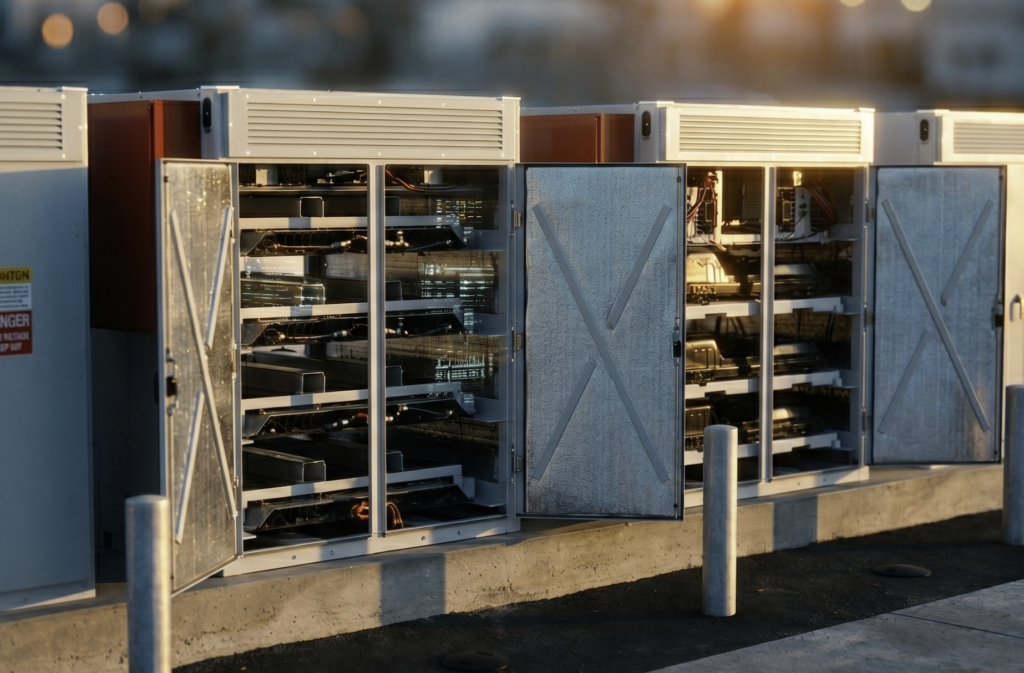
This ranked, source-verified list covers the 15 biggest battery energy storage systems (BESS) globally by energy capacity (MWh) — from the UAE’s record 19,000 MWh Masdar RTC to China’s underreported grid-side giants.
The record is moving fast. Saudi Arabia grid-connected a 7,800 MWh battery in December 2025 — more than twice the size of anything previously energized [1]. The UAE has since broken ground on a 19,000 MWh system, with a 12,500 MWh Saudi–BYD program in delivery behind it [2], [3].
In short: the world’s largest battery is a moving target, and this leaderboard gets rewritten every quarter.
Key Takeaways
- The world-record battery jumped from ~3 GWh (2024) to 7.8 GWh grid-connected (Dec 2025) to 19 GWh under construction (2026) [1], [2], [4].
- December 2025 alone added over 11 GWh of Chinese grid-side capacity, including the world’s largest single-site station at 4 GWh [5], [6].
- Chinese suppliers (BYD, Sungrow, CATL, Huawei, Envision, HyperStrong) appear in 11 of the 16 listed projects.
- Turnkey system prices fell to US$117/kWh globally in 2025 (−31% YoY) — but US/EU buyers pay 2–3x Chinese prices [7], [8].
- AI data centres are now the biggest new customer for batteries — and increasingly the intelligence operating them [6], [9].
How We Ranked the Largest BESS Projects
Before the list, three ground rules — because “world’s largest battery” claims are routinely sloppy.
We rank by energy capacity (MWh), not power (MW). Think of a battery as a bathtub: MW is how fast the tap flows, MWh is how much the tub holds. MWh determines how long a battery can power the grid after sunset, which is the job these projects exist to do.
We include operational and under-construction projects, clearly labelled. Planned-only projects — Sun Cable’s ~42 GWh Australia-Asia Power Link and India’s ~12 GWh Ladakh corridor — are excluded until construction starts.
Multi-site programs procured as one contract are marked with an asterisk (*). Purists may prefer single-site rankings; we disclose rather than hide the distinction.
The Complete Ranking: World’s Largest BESS Projects by Capacity (MWh)
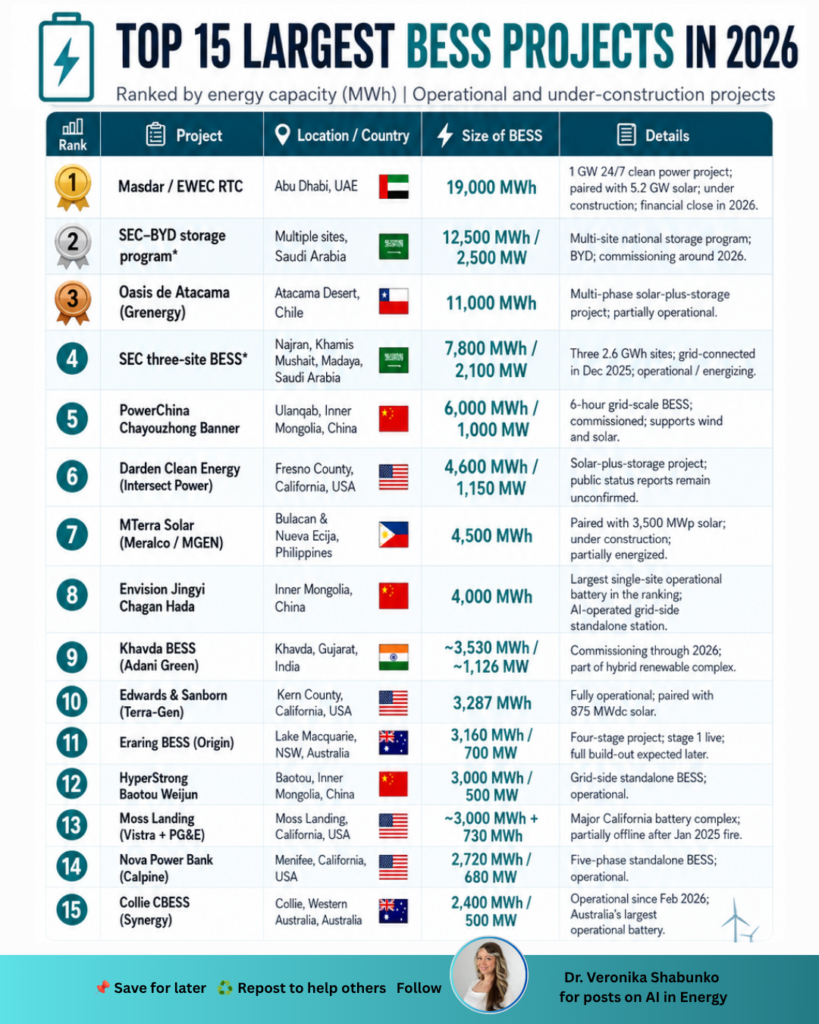
*Multi-site program counted as a single procurement. Note on Darden: public reporting conflicts on whether the project is operational or entering construction [11]; treat its status as unconfirmed. Just missing the cut: Neoen’s Collie Battery (2,240 MWh), Desert Sunlight (2,120 MWh), Ordos Gushanliang (2,000 MWh), Bisha (2,000 MWh).
At the top of the list, the largest battery storage project in the world is the Masdar/EWEC Round-the-Clock (RTC) facility in Abu Dhabi: a 19,000 MWh battery paired with 5.2 GW of solar, financed at $6.1 billion and built to deliver 1 GW of clean power 24 hours a day from 2027 [2].
Close behind sit Saudi Arabia’s 12,500 MWh SEC–BYD program [10] and Chile’s 11,000 MWh Oasis de Atacama in the world’s sunniest desert [4]. The largest battery actually connected to a grid today is Saudi Arabia’s 7,800 MWh three-site system, energized in December 2025 [1], while the largest single-site operational battery is Envision’s 4,000 MWh AI-operated station in Inner Mongolia [6].
The biggest fully operational battery in the United States remains Edwards & Sanborn in California at 3,287 MWh [4], and Australia’s crown belongs to Synergy’s 2,400 MWh Collie CBESS [16]. Together, the top 15 hold roughly 90 GWh of storage — more than the entire world deployed in a typical year of the late 2010s.
The list tells three geographic stories at once. The Gulf builds for round-the-clock industrial and AI loads. China builds grid-side giants to absorb Inner Mongolia’s wind and solar. Meanwhile, the US, Australia, India, Chile, and the Philippines build to shift midday solar into the evening peak. Different problems — one technology.
Battery Storage Trends in 2026: What’s Driving Giga-Scale BESS
AI Sits on Both Sides of the Battery
Roughly 353 GWh of storage will be added globally in 2026, with AI data centre demand named as the primary driver [9]. The Masdar RTC — number one on this list — is explicitly designed to serve the AI sector with 1 GW of continuous clean power [3].
But AI is also running the batteries. Envision’s record 4 GWh station operates on an AI system in which trading agents and grid-forming agents coordinate forecasting, dispatch, and market bidding in a closed loop [6]. The industry’s largest customer and its newest operator are the same technology.
Costs Collapsed — Into Three Different Price Worlds
BloombergNEF’s 2025 survey put the global average turnkey system at US$117/kWh, down 31% year-on-year and the lowest on record [7]. The hardware mechanism is visible across this ranking: 587Ah-class LFP cells entering mass production have pushed the standard 20-foot container from ~5 MWh to 6.25 MWh [17].
However, geography now matters more than supplier choice. Chinese buyers pay around US$101/kWh, while US and European buyers pay US$236–275/kWh for essentially the same technology [8].
LFP and the Four-Hour Standard Won
Every verifiable project on this list runs lithium-ion, overwhelmingly lithium iron phosphate (LFP) — cheaper, more thermally stable, and longer-cycling than nickel chemistries [4]. [INTERNAL LINK: your LFP explainer]
Duration stretched with it: from the 1–2 hour frequency-response systems of the late 2010s to today’s 4-hour arbitrage standard, and now 6-hour designs like PowerChina’s Inner Mongolia project [4].
Grid-Forming Goes From Optional to Mandatory
Wood Mackenzie calls 2026 “the year grid forming gets regulated,” as batteries inherit the stability duties of retiring coal and gas plants [18]. Eraring’s second stage runs in virtual synchronous machine mode [14]; the Masdar RTC specifies grid-forming inverters and black-start capability [3]; Envision’s flagship passed a 72-hour continuous grid trial on its first attempt [6]. As synchronous generators retire, grid-forming storage becomes the anchor for inverter-based grids [19]. [INTERNAL LINK: your grid stability article]
Sodium-Ion Enters the Giga-Scale Game
For a decade, “largest battery” has meant lithium. That monopoly cracked in April 2026, when CATL signed a three-year, 60 GWh sodium-ion supply agreement with HyperStrong — the largest sodium-ion order in history, and CATL’s declaration that it has “overcome the challenges of the entire sodium-ion battery mass production chain” [23].
The trade-off is clear-eyed. CATL’s grid-storage sodium cell delivers ~160 Wh/kg — below LFP’s density — but compensates with over 15,000 cycles at 80% retention and a −40°C to +70°C operating window, far wider than lithium’s comfort zone [24]. For stationary storage, where land is cheaper than cycle life, that trade can win — especially in cold climates. Sodium is also orders of magnitude more abundant than lithium and free of the geopolitical chokepoints around lithium refining.
Context matters, though: the 60 GWh appears to be a chemistry carve-out from CATL and HyperStrong’s existing 200 GWh framework rather than entirely new volume, and delivery at scale still has to be proven in the field [25]. LFP remains the default. But expect the first sodium-ion entries on future editions of this top-15 list — likely in China’s coldest provinces first.
AI in BESS: The Technology on Both Sides of the Meter
Artificial intelligence deserves its own section, because it now touches every layer of the battery story — demand, operations, and hardware.

AI as the Demand Driver
The single biggest force behind 2026’s ~353 GWh of new storage is AI data centre load [9]. Hyperscalers need firm, clean, around-the-clock power, and batteries are the fastest way to deliver it: the Masdar RTC’s entire design purpose — 5.2 GW of solar feeding a 19 GWh battery to output 1 GW continuously — is serving AI compute [3]. Storage is also expanding beyond backup at data centres into grid frequency regulation, turning server farms from pure loads into grid assets [9].
AI as the Plant Operator
The world’s largest single-site battery is run substantially by software. Envision’s 4 GWh Inner Mongolia station operates a closed-loop AI system in which trading agents and grid-forming agents coordinate forecasting, dispatch, market bidding, and self-learning [6]. HyperStrong runs AI-optimized power trading across its fleet [26]. In merchant markets, where a battery earns through thousands of trades a year, the dispatch algorithm is becoming as decisive for returns as the hardware itself.
AI Inside the Battery
The frontier — and the part to treat with appropriate skepticism — is AI-native battery management: machine-learning models monitoring cell impedance and degradation signatures to predict faults before they become fires, and to schedule capacity augmentation across a 15–20 year life. Manufacturers make strong claims here (some advertise detecting thermal-runaway precursors days in advance); independent, fleet-scale validation is still thin. Directionally real, commercially unproven — watch this space rather than bank on it.
The takeaway: AI is simultaneously the battery industry’s biggest customer, its newest operator, and its next diagnostic layer. No other technology sits on all three sides of the meter at once.
Opportunities: Where the Next Value Is Created
Long-duration energy storage (LDES). Four-hour lithium handles daily cycling; a deeply renewable grid also needs multi-day resilience. Iron-air, flow batteries, and compressed-air storage are moving from pilot to commercial scale, and they will complement rather than displace lithium — expect the first LDES entries on lists like this before 2030.
Sodium-ion at scale. The CATL–HyperStrong 60 GWh order opens a second chemistry lane [23]. For developers in cold climates or lithium-constrained supply chains, sodium’s cycle life and temperature range are genuine differentiators [24] — and a hedge against lithium price volatility.
Data-centre co-location. Batteries sited with data centres can stack revenue: backup, peak shaving, and grid services from the same asset [9]. As FERC and other regulators settle co-location rules, this becomes one of the clearest new business models in storage.
Virtual power plants and aggregation. The Saudi SEC–BYD program operates its distributed sites as a coordinated portfolio — the same logic that lets thousands of small batteries bid into markets as one plant. Software-defined capacity scales faster than steel in the ground.
The circular economy. First-generation utility packs are approaching second-life thresholds, and recycling processes recovering the large majority of critical minerals are commercially maturing [22]. Today’s giga-projects are tomorrow’s above-ground mines — and an emerging revenue line for asset owners.
Emerging markets. A 600 MWh battery would have been a world record a decade ago; in 2026 it’s a regional milestone in Zambia [4]. The technology is diffusing fast, and the next wave of giga-projects is already forming in India, Southeast Asia, and Africa.
Challenges Facing Large-Scale Battery Storage Projects
Interconnection bottlenecks. In mature Western markets, building the battery is often faster than connecting it — US interconnection queues stretch to multi-year waits [20]. The Gulf moves faster because state utilities procure storage and transmission together: Saudi Arabia’s 7.8 GWh system went from groundbreaking to a 380 kV connection in roughly a year [1].
Safety at concentration. Moss Landing stays on this list as a warning. The January 2025 fire took much of it offline and triggered the largest lithium-ion cleanup in US EPA history [4]. Its legacy is written into every newer project: LFP chemistry, unit-level separation, liquid cooling as standard, off-gas detection, and codes like NFPA 855 [21].
Market design. Giga-scale economics rely on revenue stacking — arbitrage, capacity, and ancillary services on one asset. Markets designed for one-directional fossil generation still undervalue that flexibility, which is why the fastest-growing markets have state procurement or explicit storage frameworks rather than pure merchant exposure.
What’s Next for Battery Storage: 2026 to 2030
- The 10 GWh single-procurement threshold falls in 2026 as the Saudi 12.5 GWh program and Chile’s Oasis de Atacama energize major phases — with the 19 GWh Masdar RTC taking the crown in 2027 [2], [10].
- Long-duration storage complements, not competes. Multi-day resilience will need iron-air, flow batteries, and other long-duration technologies now moving from pilot to commercial scale.
- Hardware keeps compounding. 587Ah+ cells reach mass production by end-2026 [17]; 2,000V architectures and immersion cooling remain trade-show territory for now.
- The circular economy arrives on schedule. First-generation utility packs approach second-life thresholds, and recycling recovering the large majority of critical minerals is maturing commercially [22].
- And expect this list to be outdated within two quarters. That is the most important trend of all.
Bottom line: energy storage is no longer supplementary — it is a primary pillar of grid architecture. The formula is set: GWh-scale, LFP, four-plus hours, increasingly grid-forming, increasingly AI-operated. What remains unsettled is who captures the value: the supply chain is Chinese, the boldest procurement is Gulf-state, and the deepest markets are Western.
Frequently Asked Questions
What is the largest battery storage project in the world in 2026? By full-build capacity, the Masdar/EWEC RTC project in Abu Dhabi, UAE, at 19,000 MWh (19 GWh), under construction with commercial operation expected in 2027 [2]. The largest grid-connected system is Saudi Arabia’s 7,800 MWh three-site SEC project (December 2025) [1]. The largest operational single-site battery is Envision’s 4,000 MWh station in Inner Mongolia, China [6].
What is the largest battery storage project in the United States? Edwards & Sanborn in Kern County, California (3,287 MWh), is the largest fully operational US battery [4]. Intersect Power’s Darden project (4,600 MWh) would surpass it, but public reporting on its status conflicts as of mid-2026 [11].
How is “largest battery” measured — MW or MWh? By energy capacity in megawatt-hours (MWh), which measures how much electricity the battery stores. Megawatts (MW) measure how fast it charges or discharges. MWh is the standard for comparing storage scale.
What battery chemistry do the largest BESS projects use? Almost universally lithium iron phosphate (LFP) lithium-ion, chosen for thermal stability, long cycle life, and cost — supplied predominantly by Chinese manufacturers including BYD, Sungrow, CATL, Huawei, Envision, and HyperStrong.
How much does grid-scale battery storage cost in 2026? The global average turnkey system price was US$117/kWh in 2025, down 31% year-on-year, per BloombergNEF — with sharp regional divergence: roughly US$101/kWh in China versus US$236/kWh in the US and US$275/kWh in Europe [7], [8].
How is AI used in battery energy storage? AI now drives BESS from both sides. On the demand side, AI data centres are the primary driver of 2026’s ~353 GWh of new storage, since they need firm clean power around the clock. On the operations side, AI forecasts prices, trades the battery in power markets, and coordinates grid support — Envision’s 4,000 MWh station in China runs largely on autonomous AI agents.
References
[1] pv magazine, “Saudi Arabia connects 7.8 GWh battery storage project to grid,” Dec. 18, 2025. https://www.pv-magazine.com/2025/12/18/saudi-arabia-connects-7-8-gwh-battery-storage-project-to-grid/
[2] Saur Energy, “Masdar reaches financial close on $6.1 billion 5.2 GW solar and 19 GWh BESS project,” Jul. 2026. https://www.saurenergy.com/solar-energy-news/masdar-reaches-financial-close-on-61-billion-52-gw-solar-and-19-gwh-bess-project-12165680
[3] Energy-Storage.news, “Masdar picks Sungrow as supplier for world’s largest 24/7 renewable energy project in UAE,” May 22, 2026. https://www.energy-storage.news/masdar-picks-sungrow-as-supplier-for-worlds-largest-24-7-renewable-energy-project-in-uae/
[4] K. Talar, “The largest battery storage in the world 2026,” Apr. 19, 2026. https://howtostoreelectricity.com/largest-battery-storage-in-the-world/
[5] HyperStrong, “HyperStrong sets global benchmark with 7.4 GWh grid-side energy storage projects in Inner Mongolia,” Dec. 2025. https://www.hyperstrong.com/en/news/company-news/81
[6] ESS News, “World’s largest AI-powered 12.8 GWh battery storage cluster comes online in China,” Feb. 5, 2026. https://www.ess-news.com/2026/02/05/worlds-largest-ai-powered-12-8-gwh-battery-storage-cluster-comes-online-in-china/
[7] Energy-Storage.news, “Battery storage system prices continue to fall sharply, BNEF and Ember reports find,” Dec. 16, 2025. https://www.energy-storage.news/battery-storage-system-prices-continue-to-fall-sharply-bnef-and-ember-reports-find/
[8] Energy-Storage.news, “Behind the numbers: BNEF finds 40% year-on-year drop in BESS costs,” Jan. 16, 2026. https://www.energy-storage.news/behind-the-numbers-bnef-finds-40-year-on-year-drop-in-bess-costs/
[9] Energy Industry Review, “Battery storage capacity: Record growth and trends in 2026,” Apr. 30, 2026. https://energyindustryreview.com/power/battery-storage-capacity-record-growth-and-trends-in-2026/
[10] BYD Energy Storage, “BYD Energy Storage signed world’s largest grid-scale battery storage projects of 12.5GWh,” Feb. 17, 2025. https://seekingalpha.com/pr/20003781-byd-energy-storage-signed-world-s-largest-grid-scale-battery-storage-projects-of-12_5gwh
[11] Blackridge Research, “Top battery energy storage system (BESS) projects around the world,” May 2026. https://www.blackridgeresearch.com/blog/latest-list-top-battery-energy-storage-system-bess-electro-chemical-projects-around-the-world
[12] Meralco PowerGen, “MTerra Solar now delivering power to the Luzon grid,” Mar. 17, 2026. https://www.meralcopowergen.com.ph/mterra-solar-now-delivering-power-to-the-luzon-grid/
[13] Energy-Storage.news, “Huawei to provide 4.5GWh BESS for Philippines Terra Solar project,” Dec. 10, 2024. https://www.energy-storage.news/huawei-to-provide-4-5gwh-bess-for-philippines-terra-solar-project/
[14] Origin Energy, “Largest battery in Southern Hemisphere to get even bigger,” Dec. 11, 2025. https://www.originenergy.com.au/about/investors-media/largest-battery-in-southern-hemisphere-to-get-even-bigger/
[15] Energy-Storage.news, “Calpine to bring majority of 680MW California BESS online this summer,” Apr. 5, 2024. https://www.energy-storage.news/calpine-to-bring-majority-of-680mw-california-bess-online-this-summer/
[16] Energy-Storage.news, “Australia’s largest operational BESS: Synergy completes CATL-powered 2,400MWh Collie Battery,” Feb. 9, 2026. https://www.energy-storage.news/australias-largest-operational-bess-synergy-completes-catl-powered-2400mwh-collie-battery/
[17] EVreporter, “The rise of 587Ah cells and 6.25MWh battery energy storage systems,” Mar. 14, 2026. https://evreporter.com/the-rise-of-587ah-cells-and-6-25mwh-battery-energy-storage-system/
[18] ESS News, “Analyst delivers five trends to look for in global energy storage in 2026,” Jan. 27, 2026. https://www.ess-news.com/2026/01/27/analyst-delivers-five-trends-to-look-for-in-global-energy-storage-in-2026/
[19] B. Kroposki et al., “Achieving a 100% renewable grid,” IEEE Power and Energy Magazine, vol. 15, no. 2, pp. 61–73, Mar./Apr. 2017.
[20] Lawrence Berkeley National Laboratory, “Queued Up: Characteristics of power plants seeking transmission interconnection.” https://emp.lbl.gov/queues
[21] National Fire Protection Association, “NFPA 855: Standard for the Installation of Stationary Energy Storage Systems,” 2023 ed.
[22] G. Harper et al., “Recycling lithium-ion batteries from electric vehicles,” Nature, vol. 575, pp. 75–86, Nov. 2019.
[23] Energy-Storage.news, “‘A turning point’: CATL and HyperStrong sign 60GWh sodium-ion agreement,” Apr. 27, 2026. https://www.energy-storage.news/a-turning-point-catl-and-hyperstrong-sign-60gwh-sodium-ion-agreement/
[24] newmobility.news, “CATL turns sodium-ion into a grid reality with a 60 GWh landmark deal,” Apr. 29, 2026. https://newmobility.news/en/2026/04/29/catl-turns-sodium-ion-into-a-grid-reality-with-a-60-gwh-landmark-deal/
[25] ESS News, “CATL secures world’s largest sodium-ion battery order with HyperStrong,” Apr. 27, 2026. https://www.ess-news.com/2026/04/27/catl-secures-worlds-largest-sodium-ion-battery-order-with-hyperstrong/
[26] ESS News, “CATL, HyperStrong sign massive 200 GWh battery supply agreement for energy storage,” Nov. 14, 2025. https://www.ess-news.com/2025/11/14/catl-hyperstrong-sign-massive-200-gwh-battery-supply-agreement-for-energy-storage/